
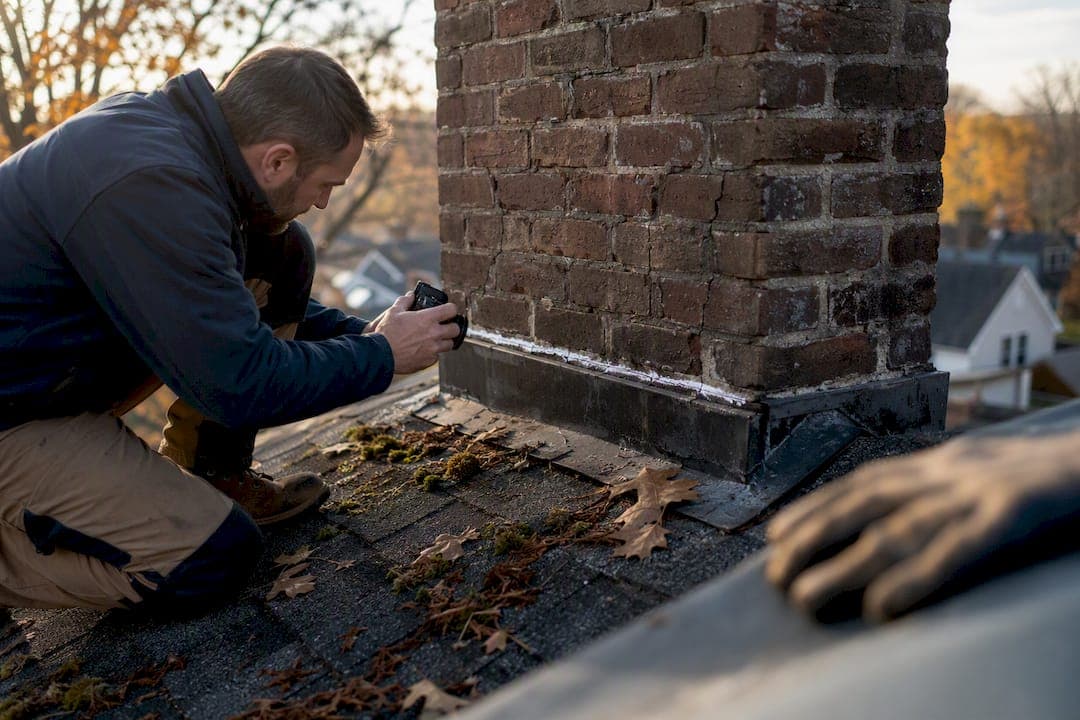
A leaning chimney, active cracking, or falling masonry fragments mean stop using the fireplace and call a professional right away. Crumbling mortar or a few loose bricks usually means a scheduled repair, not a crisis. Basic repointing and flashing work typically runs £600 to £1,500 in the UK, while a full rebuild costs considerably more. If you see movement, make the area safe, take photos, and get an inspection booked.
TL;DR:
- Crumbling mortar joints, growth of plants or moss, and loose bricks are early signs that indicate the need for repair or inspection.
- Movement detected through widening gaps or leaning beyond 1mm in 100mm suggests a structural risk requiring immediate professional assessment.
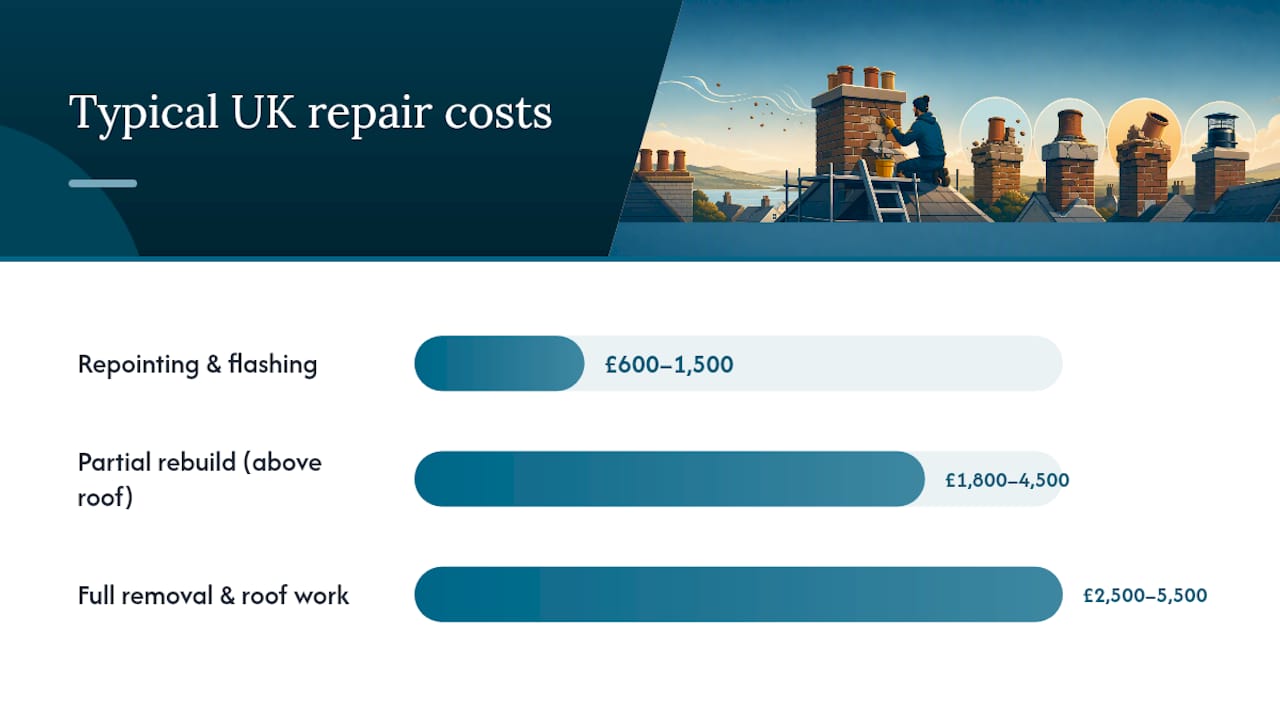
- Repointing costs in the UK range from £600 to £1,500, while full rebuilds can exceed £4,500, depending on damage extent and access difficulty.
- Water ingress from cracked crowns or failed flashing accelerates deterioration, making timely repairs like sealing or partial rebuilds essential.
- Regular biannual inspections, gutter maintenance, and prompt mortar crack repairs can significantly extend chimney lifespan and prevent costly rebuilds.
Table of Contents
- Recognizing the Warning Signs of Chimney Stack Repair Needs
- Why Chimneys Fail: The Common Underlying Causes
- Repair Types and When Each One Applies
- What Happens During a Chimney Inspection and Repair Project
- How to Choose a Contractor for Chimney Stack Repair
- Budgeting for Chimney Stack Repair: Costs and What Drives Them
- Safety First: What to Do About an Unstable Chimney
- Why Professional Chimney and Roofline Work Matters
- Materials and Tools Used in Chimney Stack Repair
- Seasonal Considerations and Best Timing for Chimney Repairs
- Maintenance Tips to Extend the Life of Your Chimney Stack
- The Real Lesson in Chimney Stack Repair: Watch, Don't Wait
- Get a Free Chimney Stack Repair Quote from J.H. Roofing
- Sources
Recognizing the Warning Signs of Chimney Stack Repair Needs
Your chimney tells you it's in trouble long before it becomes dangerous. The problem is that most homeowners never look up long enough to notice.
Exterior symptoms are usually the first clue, and they're visible from the ground with a decent pair of binoculars:
- Crumbling or missing mortar joints between bricks
- Spalled bricks (the face has cracked, popped off, or flaked away)
- Plants or moss growing from joints, which signals trapped moisture
- Loose or shifted chimney pots sitting at an odd angle
- Brick fragments or mortar dust collecting in the gutters below
Interior signs are easier to miss because they don't look chimney-related at first glance. Damp staining on the chimney breast or ceiling near the flue, a sudden smell of smoke drifting into rooms when a fire is lit, drafts that seem to come from nowhere, and debris or grit collecting in the hearth all point back to the same source: a stack that's letting water or gas in where it shouldn't.
Movement is the detail that separates a cosmetic problem from a structural one. Take a photo of the stack from the same spot every few months, lined up against a fixed reference point like a roof edge or a nearby drainpipe. Surveyors commonly use what's known as the 1mm-in-100mm rule as an indicator of an unsafe lean, though historic buildings are sometimes judged against different tolerances, like the "middle third" principle for older masonry.
Pro Tip: Chalk a small line where the chimney meets the roofline and check it every season. A gap that widens over a few months is a far bigger red flag than one that's stayed the same size for years.
Why Chimneys Fail: The Common Underlying Causes
Repointing the same section of a chimney every few years without asking why it keeps failing wastes money. Most stack problems trace back to a handful of repeat offenders.
- Freeze-thaw cycles. Water seeps into brick and mortar, freezes, expands, and cracks the surface. Repeat that a hundred times over a decade and bricks spall.
- Water ingress through failed flashing or crowns. Once water gets behind the flashing or through a cracked crown, it has nowhere to go but into the masonry, where it sits and does slow damage.
- Sulfate attack and material fatigue. Chemical reactions between mortar and moisture over time weaken joints from the inside out, especially in older stacks.
- Footing or foundation settlement. A chimney is a heavy, independent structure. If the ground beneath it shifts, the whole stack can lean, even when the brickwork itself is sound.
- Poor past repairs. Hard cement mortar patched onto old, breathable brickwork is one of the most common mistakes. It traps moisture inside the wall instead of letting it escape, which accelerates spalling rather than preventing it.
Think of a chimney stack as a system, not a single object. The crown, the flashing, the flue lining, and the masonry all depend on each other, and fixing one piece while ignoring another tends to buy you a year or two at most before the same symptoms come back.
Repair Types and When Each One Applies
Not every chimney problem needs a full rebuild, and not every crack can be solved with a bag of mortar. Matching the repair to the actual defect is where most of the value gets decided.
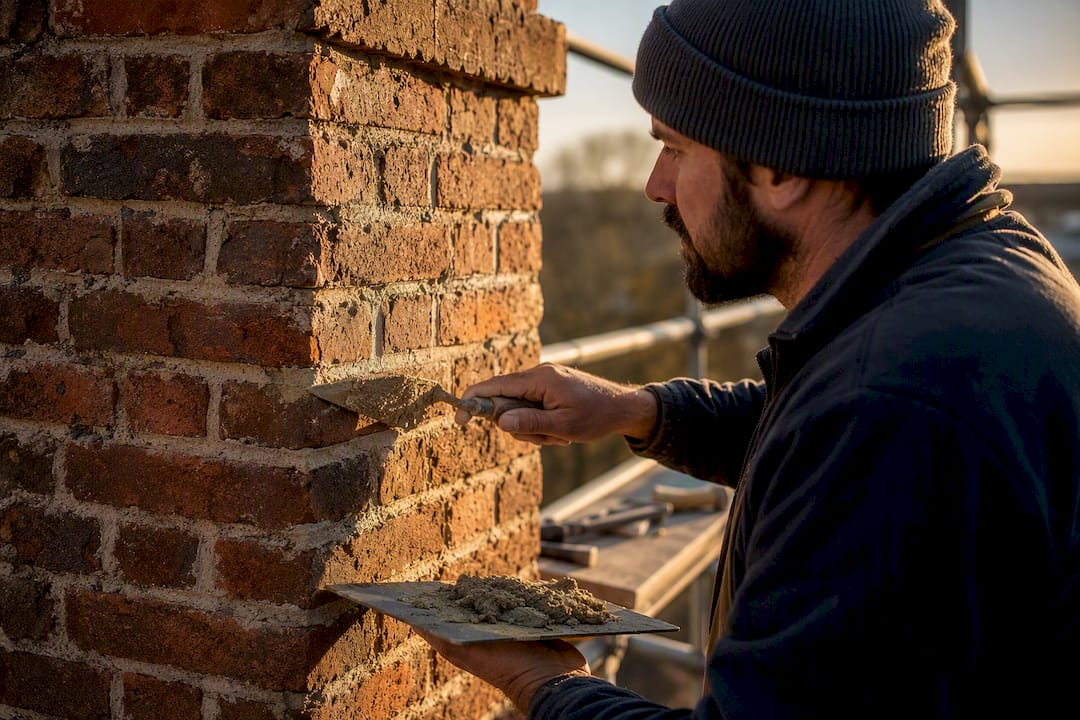
Repointing (tuckpointing) is the right call when the brick units themselves are still structurally sound but the mortar joints have eroded or crumbled. A contractor rakes out the old, failed mortar to a consistent depth and repacks the joints with fresh material, ideally lime-based mortar on older properties so moisture can still move through the wall. Done correctly, tuckpointing can meaningfully extend the life of a chimney by restoring its weather resistance.
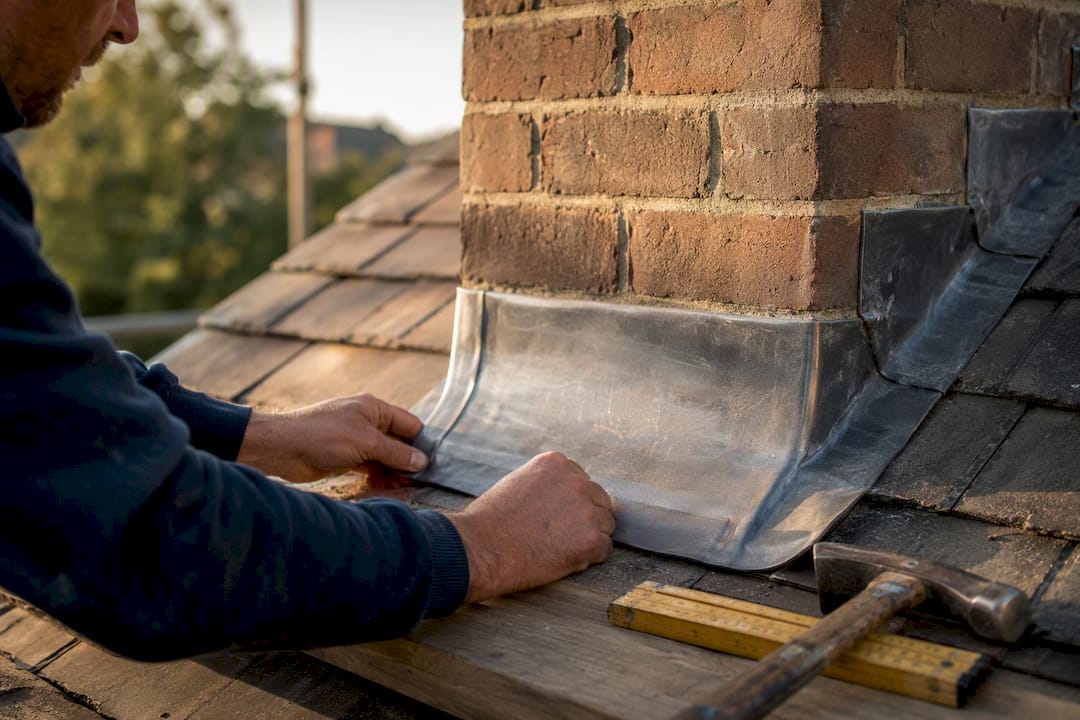
Flashing repairs address the metal seal where the chimney meets the roofline. This is one of the sneakiest problems in the whole list, because a leak that looks like a masonry failure is often just a lifted or corroded flashing strip letting water run down behind the stack.
Crown and flaunching work targets the concrete or mortar cap on top of the stack. A crown with hairline cracks can often be resurfaced. One with deep splits or sections missing usually needs a full rebuild, because water pooling on a damaged crown accelerates everything else on this list.
Chimney pot replacement matters more than most homeowners assume. A cracked or missing pot changes airflow and weather protection at the top of the flue, which can cause downdrafts or accelerated water damage lower in the stack.
Partial versus full rebuild comes down to how much of the stack shows genuine structural compromise. If damage is limited to the top few courses of brick, a partial rebuild from roofline up is usually enough. Full rebuilds, or full removal, get triggered by widespread spalling, active leaning, or a compromised base.
Relining solves a different problem entirely: flue performance and condensation. If smoke isn't drawing properly or acidic condensation is eating into the flue from the inside, a new liner (often stainless steel or a cast-in-place system) addresses the issue without touching the exterior masonry at all.
| Repair type | Typical trigger | Indicative UK cost |
|---|---|---|
| Repointing and flashing repair | Eroded joints, minor leaks | £600 to £1,500 |
| Crown or flaunching repair | Cracked cap, water pooling | Included within repointing range for minor work |
| Chimney stack rebuild (above roofline) | Widespread spalling, moderate lean | £1,800 to £4,500 |
| Full removal and roof making-good | Structural failure, unsafe stack | £2,500 to £5,500 |
Homeowners outside the UK will see different numbers. US-focused cost data shows simple repairs averaging $160 to $750, while complex rebuilds involving full masonry replacement can run considerably higher depending on access and local labor rates.
What Happens During a Chimney Inspection and Repair Project
Booking an inspection can feel like an unknown quantity if you've never had chimney work done before. Here's roughly how a competent contractor approaches it.
- Ground-level and loft checks first. A contractor starts by looking at the stack from ground level with binoculars, checking the loft space for daylight, damp staining, or displaced flashing, and photographing anything of concern.
- Drone or camera survey for hard-to-reach stacks. On taller properties or steep roofs, a drone survey gives a much closer look at crown condition and mortar joints without anyone needing to climb up first.
- Structural engineer involvement when needed. Stepped cracks, an active lean beyond the 1mm-in-100mm threshold, or visible foundation movement should trigger a referral to a qualified surveyor or structural engineer before any repair work begins.
- Scaffolding or tower scaffold goes up. Almost all chimney stack work above roofline height requires scaffolding for safe, stable access. This is one of the biggest cost and timeline factors on any quote.
- Repair, then roofmaking-good. After the masonry work, the contractor reinstates flashing, tidies the roof covering around the stack, and clears away debris and waste materials.
Timelines vary by scope. Minor repointing can be a one to two day job once scaffolding is up. A partial rebuild typically takes three to five days. A full rebuild, especially one involving structural assessment first, can stretch to one or two weeks including scaffold hire.
Pro Tip: Ask your contractor whether the quote includes scaffold hire as a separate line item. Some quotes bundle it in, others charge it independently, and that single difference can make two quotes look wildly apart in price when the actual repair scope is identical.
How to Choose a Contractor for Chimney Stack Repair
The gap between a repair that lasts fifteen years and one that fails in two often comes down to who you hired, not what material they used.
Start with credentials. Ask to see proof of public liability insurance, confirm they carry appropriate trade qualifications, and check recent local reviews rather than testimonials on the company's own site. A contractor who does chimney and leadwork alongside general roof repairs tends to catch problems that a chimney-only specialist might miss, since flashing and roofline detailing are directly connected to stack performance.
Questions worth asking before you sign anything:
- What mortar mix will you use, and is it compatible with my existing brickwork?
- Can you provide a written scope of work, not just a verbal estimate?
- How will scaffolding be arranged, and is it included in the quote?
- What happens to waste materials and old brick debris?
- Is there a written guarantee on the work, and for how long?
- What's the realistic timescale, including weather contingency?
Red flags are usually easy to spot once you know what to look for. An unusually low quote compared to everyone else, pressure to patch quickly without explaining why, and reluctance to put anything in writing are all signs to walk away. Professional roof and chimney repairs require specialist high-altitude skills, and DIY attempts at height on a compromised stack are far more likely to cause injury or worse damage than to save money.
If a contractor sees signs of active lean, stepped cracking, or possible footing movement, they should be the one telling you to get a structural report, not brushing past it to close the sale.
Pro Tip: A contractor who wants to inspect from the loft as well as the roof, not just the exterior, is usually more thorough than one quoting from a driveway photo alone.
Budgeting for Chimney Stack Repair: Costs and What Drives Them
Quotes for what looks like the same job can differ by thousands, and it rarely comes down to one contractor overcharging. A handful of factors consistently move the price.
Height and access top the list. A stack on a steep, three-story roof needs more scaffolding, more labor time, and more caution than a single-story bungalow chimney, even if the masonry damage looks identical. The extent of decay matters just as much: a stack that needs the top three courses rebuilt costs far less than one requiring a full rebuild from roofline to base. Shared stacks on semi-detached or terraced properties add coordination complexity, and any structural work or roof making-good on top of the chimney repair itself adds to the final bill.
- Complex US rebuilds: up to $15,000 depending on material and access
Insurance and mortgage lenders sometimes enter the picture too. Homeowners insurance often covers chimney damage, but insurers generally expect the chimney was in reasonable condition when the policy started, and may deny claims tied to long-term neglect. Lenders can also require proof of repair or a completed rebuild before releasing funds on a property sale if a survey flags an unstable stack.
Safety First: What to Do About an Unstable Chimney
If you spot large cracks, active movement, or masonry falling from the stack, treat it as urgent. Stop using any fireplace or appliance that vents into that chimney immediately, and keep people and pets away from the area directly beneath it.
- Take photos of the damage from a safe distance for the contractor and any insurance claim
- Call a professional the same day, not "sometime this week"
- Make sure working smoke and carbon monoxide alarms are installed, since a compromised chimney can allow flue gases to escape into the home instead of venting outside
- Never attempt to inspect or patch a leaning or actively cracking stack yourself
A professional "make safe" response might involve temporary bracing, cordoning off the area below, or partial removal of loose sections while a full repair plan gets arranged, often coordinated alongside expert roofing services to ensure comprehensive protection. None of that is a DIY job. Working at height on an already unstable structure is exactly the scenario ladders and good intentions were never built for.
Why Professional Chimney and Roofline Work Matters
A chimney rarely fails in isolation. The masonry, the flashing, and the surrounding roof covering all interact, which is why the strongest results come from contractors who handle chimney, leadwork, and roofline repairs as one connected job rather than three separate call-outs.
Jhroof has worked across residential and commercial properties in Kent for over 10 years, fully insured, with a 24-hour emergency response service for situations that can't wait for a scheduled slot. Customer feedback has held at a 4.7-star Google rating, which reflects consistency across repeat jobs rather than one standout project.
A recent flat roof replacement case study in Kent illustrates the same principle that applies to chimney work: integrated detailing around junctions and flashing points is what prevents the same leak from reappearing eighteen months later. A stack rebuilt perfectly but reconnected to the roof with poor flashing will leak again regardless of how good the brickwork looks. Contractors who understand both trades close that gap.
Materials and Tools Used in Chimney Stack Repair
The materials that go into a chimney stack repair matter as much as the labor. Mortar mix is the biggest variable: lime-based mortars are generally preferred on older, breathable brickwork because they let moisture escape naturally, while modern cement-based mixes are stiffer and can trap water against softer historic brick, which accelerates spalling over time.
Brick and stone selection matters too, especially on visible rebuilds where matching the existing color and texture keeps the repair from looking like a patch job for decades to come. Reclaimed brick is often used on period properties for exactly this reason.
For flashing, lead remains the standard material for chimney to roof junctions because of its flexibility and long service life, though some contractors use modern flexible flashing alternatives on lower-budget jobs. Crown and flaunching repairs typically use a sand and cement mix formulated to shed water, sometimes finished with a bell-shaped profile that directs rain away from the brickwork below.
On the equipment side, scaffolding or tower scaffold is standard for anything above single-story height, both for safety and to give the mason a stable, flat working platform. Drone cameras are increasingly used for initial surveys before any physical access is arranged, cutting down on wasted scaffold hire for jobs that turn out to be minor. Where a leaning chimney is caused by footing movement rather than masonry decay, some contractors now use helical piers or hydraulic jacking to stabilize the base, avoiding a full demolition where the foundation is the real problem.
Seasonal Considerations and Best Timing for Chimney Repairs
Timing a chimney stack repair around the calendar isn't just about convenience. Mortar needs a reasonable temperature window to cure properly, and most masons avoid new mortar work when overnight temperatures are close to freezing, since frozen mortar loses strength and can crack before it ever sets.
Late spring through early autumn tends to be the most reliable window for major masonry work in most temperate climates, giving mortar time to cure in stable, mild conditions. That said, booking during this period also means competing with everyone else who had the same idea, so lead times for contractors often stretch longer in summer than in the shoulder seasons.
Waiting until winter to address a known problem carries its own risk. Freeze-thaw cycles are precisely what causes spalling and cracked mortar in the first place, so a stack with existing damage tends to deteriorate faster over a cold winter than it would sitting untouched through a mild autumn. If you spot warning signs in October, it's usually worth getting at least a make-safe assessment done before the first hard frost, even if the full repair gets scheduled for spring.
Emergency repairs, of course, don't wait for good weather. A chimney showing active movement or falling masonry needs attention regardless of season, and reputable contractors carry weatherproofing measures like temporary covers to protect an open repair site until conditions improve enough to finish the job properly.
Maintenance Tips to Extend the Life of Your Chimney Stack
Most chimney stack repairs are preventable with a bit of regular attention, and the maintenance itself costs a fraction of a rebuild.
Get into the habit of a visual check twice a year, ideally in spring and autumn, looking for the warning signs already covered: crumbling mortar, vegetation, loose pots, and staining around the chimney breast inside the house. Keep gutters clear near the base of the chimney, since blocked gutters can hold water against the base of the stack and speed up moisture damage.
Have the flue swept regularly if the fireplace is in active use, since soot buildup affects draw and can hide early signs of liner damage. Address small mortar cracks or gaps as soon as you notice them rather than waiting for a full season of freeze-thaw cycles to widen them into something bigger. And if your property has a shared chimney stack with a neighbor, coordinate on maintenance timing where possible. Repairing your half while the other side stays neglected rarely solves the underlying moisture problem for either property.
A chimney that gets checked every year rarely needs the £2,500 to £5,500 full rebuild scenario. It's the ones left alone for a decade that end up there.
The Real Lesson in Chimney Stack Repair: Watch, Don't Wait
Most chimney advice treats every crack like an emergency or every mortar gap like it can wait forever. Neither extreme serves homeowners well. The actual pattern that shows up across cost data and safety guidance is that chimneys fail slowly, then suddenly, and the window between "monitor it" and "urgent" is usually measured in seasons, not years.
Where conventional advice falls short is in treating repointing as a standalone fix. A stack is a system: crown, flashing, flue, and masonry all lean on each other. Fixing mortar joints while ignoring a lifted flashing strip just buys you a year before the same stain reappears on the ceiling.
If there's one priority worth acting on, it's documentation. Photograph your chimney against a fixed reference point twice a year. That habit alone turns a vague worry into a data point, and it's the difference between catching a lean at 1mm in 100mm and discovering it after a storm brings bricks down into the garden.
— Gabbi
Get a Free Chimney Stack Repair Quote from J.H. Roofing
Jhroof handles chimney and leadwork repairs as part of the same job as your roof, not as a separate call-out with a separate contractor learning your property from scratch. That matters because flashing, crown work, and roofline detailing all touch the same junction points a chimney relies on for weatherproofing.

If you've spotted crumbling mortar, a leaning stack, or damp staining creeping down from the chimney breast, Jhroof offers free, no-obligation quotes across Kent, backed by a 24-hour emergency response service for anything that can't wait. When you reach out, have a few photos ready, note whether the fireplace or flue is currently in use, and describe what you've noticed, whether that's a visible lean, falling debris, or an interior leak. Browse the full range of roofing services in Kent covering repairs, re-roofs, and leadwork, or use the roof quote calculator for an instant estimate before booking an inspection.