
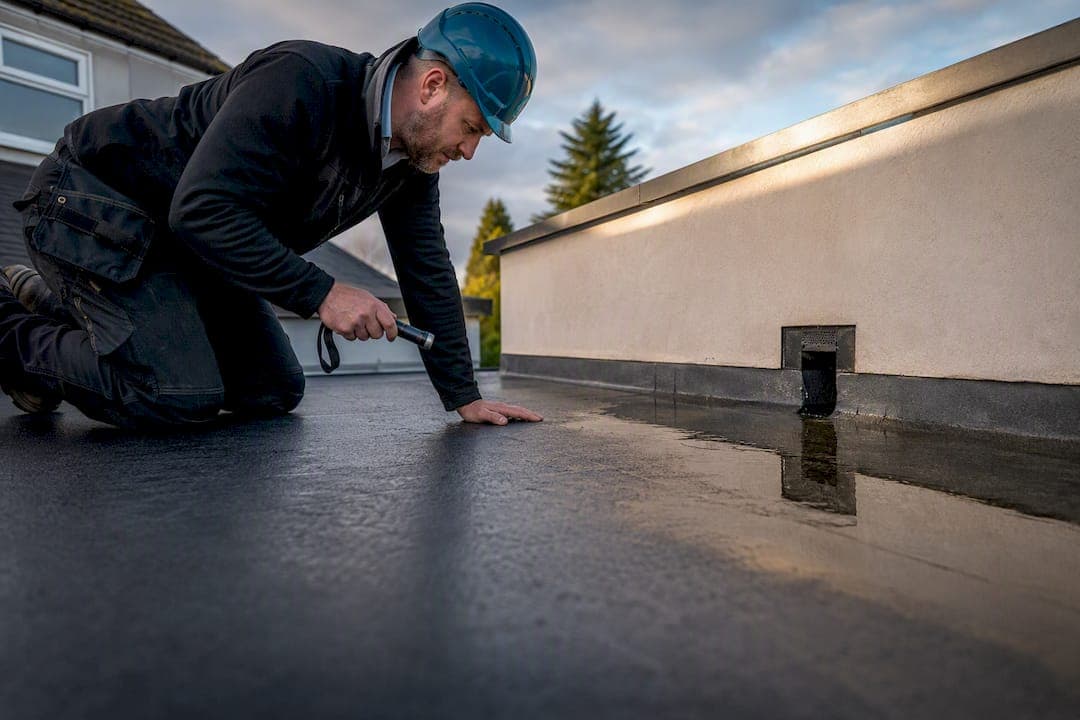
Most flat roofs last between 20 and 35 years, depending on the material installed, but the biggest swing factor isn't the membrane you choose. It's how well it was installed and how well the roof drains. A cheap membrane put on right will often outlast an expensive one put on wrong. Here's what actually determines flat roof lifespan, material by material.
TL;DR:
- Installation quality and proper drainage are the most critical factors influencing flat roof lifespan, regardless of membrane material.
- Poor detailing at junctions and inadequate flashing can significantly shorten a roof's lifespan, often more than the membrane type itself.
- Many roofs fail due to ponding water and trapped moisture, which accelerate degradation and can lead to early replacement needs.
- Routine inspections and timely minor repairs can extend a roof's life by up to 8 years and help preserve warranty coverage.
- Full replacement becomes unavoidable mainly when insulation is soaked or membrane failure is structural, not just surface-level issues.
Table of Contents
- What Is the Typical Lifespan of Each Flat Roof Material?
- Why Do Identical Roofs Age So Differently?
- What Are the Warning Signs a Flat Roof Needs Replacing?
- How Do You Extend the Life of a Flat Roof?
- Is It Better to Refurbish or Replace an Aging Flat Roof?
- A Real Kent Case Study: What Actually Determined This Roof's Lifespan
- The Maintenance Gap Nobody Talks About
- Get a Straight Answer on Your Flat Roof's Condition
- Sources
What Is the Typical Lifespan of Each Flat Roof Material?
Not all flat roofing materials age the same way, and the gap between the low end and high end of each range usually comes down to installation quality and upkeep, not luck.
- EPDM (rubber membrane): 25 to 35 years. EPDM roof lifespan tends to sit at the top of the range because the rubber resists UV breakdown well, but the seams are the weak point. Poorly bonded or under-taped seams are where EPDM roofs fail early.
- TPO: 20 to 30 years. TPO relies on heat-welded seams rather than adhesive, which is generally stronger when done correctly, but the welds are sensitive to temperature and technician skill. A rushed weld on a cold day is a common failure point.
- PVC: 25 to 30 years. PVC resists chemicals and grease well, which makes it a common choice for commercial kitchens and restaurants. Older PVC formulations sometimes lost plasticizers over time and became brittle, though modern products have largely addressed that.
- Modified bitumen: 15 to 25 years. This is a torch-applied or self-adhered bituminous system, and it's usually more affordable upfront. The cap sheet is the vulnerable layer. Once it cracks or blisters, water gets underneath quickly.
- Built-up roofing (BUR): 20 to 30 years. The traditional layered gravel-and-tar system is heavy but durable, and it handles foot traffic better than most single-ply membranes.
- GRP (fiberglass) roofing: Typically 25 to 30 years when installed on a sound, dry deck. GRP roof lifespan depends heavily on the substrate underneath. It's a rigid, seamless system, which is why it's popular on flat-roof extensions and dormers where junctions are tricky.
- Liquid-applied and spray-applied systems (SPF): 15 to 20 years, though these are often used more for refurbishment than new installation.
- Metal standing-seam flat roofs: 30 to 50 years, but the installation cost and complexity are higher, and they're less common on domestic flat roofs than the membrane options above.
Across the board, field-verified lifespan data confirms that TPO, EPDM, PVC, modified bitumen, and BUR all show wide ranges within their category, with installation and maintenance quality accounting for most of the difference. Manufacturer warranties reflect this too: most reputable membrane makers offer 20-year warranties as their common upper tier, though some EPDM and PVC products stretch further when installed by an approved contractor.
Why Do Identical Roofs Age So Differently?
Two roofs with the same membrane, installed the same year, can age a decade apart. The reason almost always traces back to a handful of variables that have nothing to do with the material itself.
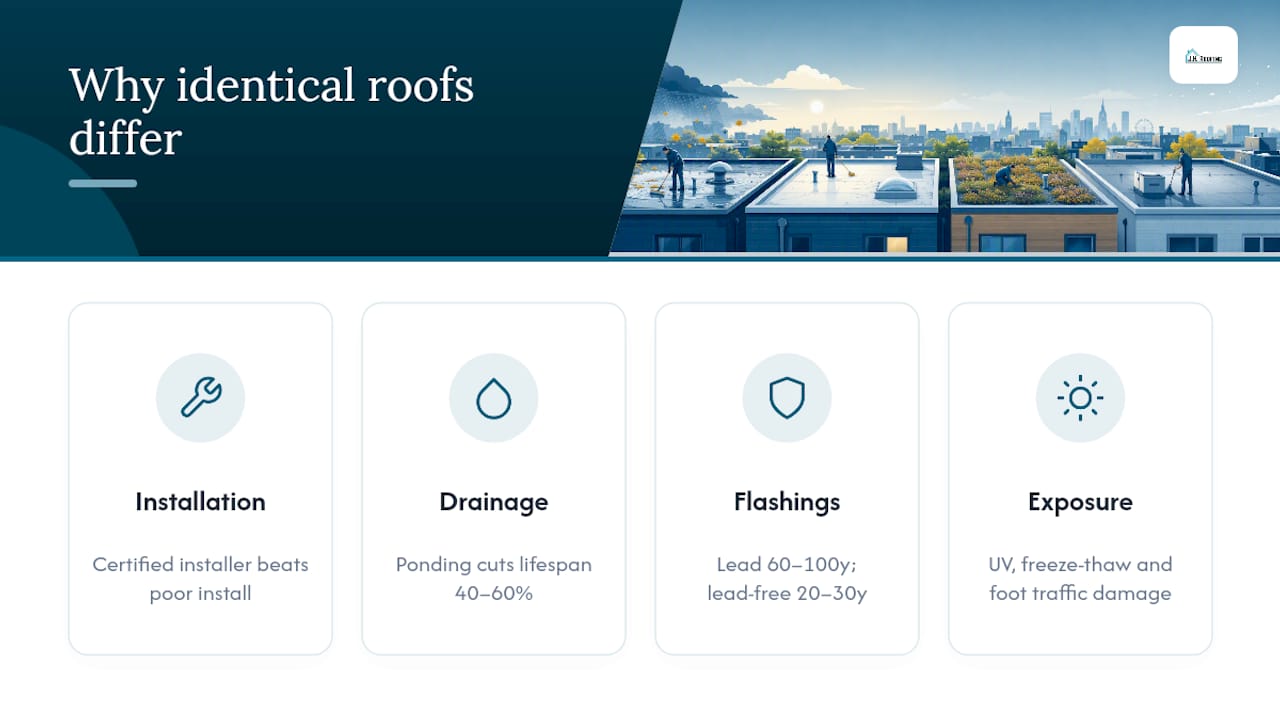
Installation quality is the single biggest factor. Seam welding on TPO, correct overlap on EPDM, and properly dressed parapet flashing all determine whether water finds a way in within five years or twenty-five. A certified installer with correct detailing will typically outperform a premium membrane installed poorly.
Drainage and ponding water do serious damage over time. A flat roof isn't actually flat. It needs a slight fall, usually built into the insulation layer, so water reaches the outlets instead of sitting still. Chronic ponding can cut lifespan by as much as 40 to 60 percent compared to a properly draining roof, because standing water accelerates UV degradation and finds every pinhole eventually.
Flashings and junctions matter more than most homeowners realize. Lead flashing can last 60 to 100 years or more, which is why it's been the industry standard for so long. Lead-free flashing alternatives, often PIB or modified bitumen composites, typically carry 20 to 30 year guarantees and reduce theft risk since scrap lead theft is a genuine problem on some properties. Products like Wakaflex offer flexible, BBA-approved detailing for complex junctions, though they're built for flashing work, not as a flat-roof membrane substitute.
Climate exposure and foot traffic shorten lifespans in different ways. UV exposure and freeze-thaw cycling both stress membranes, and rooftop equipment, satellite dishes, or regular foot traffic wear down surfaces that were never designed to be walked on.
Pro Tip: Ask your installer which flashing type they're specifying and why. If they can't explain the lifespan trade-off between lead and lead-free options for your specific junctions, get a second opinion before signing off.
What Are the Warning Signs a Flat Roof Needs Replacing?
Most flat roofs don't fail suddenly. They send warning signs for months or years before a full replacement becomes unavoidable.
- Repeated leaks in the same spot despite patch repairs usually mean the membrane has failed structurally, not just at one point.
- Visible ponding that doesn't drain within 48 hours after rain points to a slope or drainage problem that patching won't fix.
- Blistering or bubbling on the membrane surface signals trapped moisture underneath, which will keep spreading.
- A soft or spongy feel underfoot often means the deck itself is rotting, a much bigger problem than the membrane.
- Saturated insulation discovered during a repair is usually the tipping point. A 25-year-old EPDM roof with soaked insulation is rarely worth patching again. That's a replacement job.
How Do You Extend the Life of a Flat Roof?
Twice-yearly inspections, once in spring and once in autumn, catch small problems before they become expensive ones. Bring a simple checklist: clear debris from drains and gutters, check flashing edges for lifting, inspect seams for separation, and photograph anything questionable so you have a record over time.
Between full inspections, a few routine habits do most of the work:
- Clear leaves and moss from outlets after every storm.
- Check pipe collars and rooflight upstands for cracking.
- Reseal lifting seam edges as soon as you spot them, not months later.
- Trim overhanging branches that drop debris or scrape the surface.
Mid-life interventions can genuinely buy years. A recoat, a local membrane repair over a weak seam, or a reseal of aging flashings can add 5 to 8 years to a roof that's showing early wear but isn't structurally compromised. Beyond the lifespan benefit, documented maintenance is often what insurers and manufacturers ask for if you ever need to make a warranty claim. A roof with no maintenance history is a much harder sell for a claim than one with two inspection reports a year.
Is It Better to Refurbish or Replace an Aging Flat Roof?
The right call depends on what's underneath the surface, literally. A liquid-applied coating over a sound membrane is the cheapest option and can add roughly 5 to 10 years if the substrate is still dry and structurally intact. An overlay membrane, essentially a new layer bonded over the old one, works well when the existing roof is stable but tired, and can add 10 to 15 years depending on the base material.
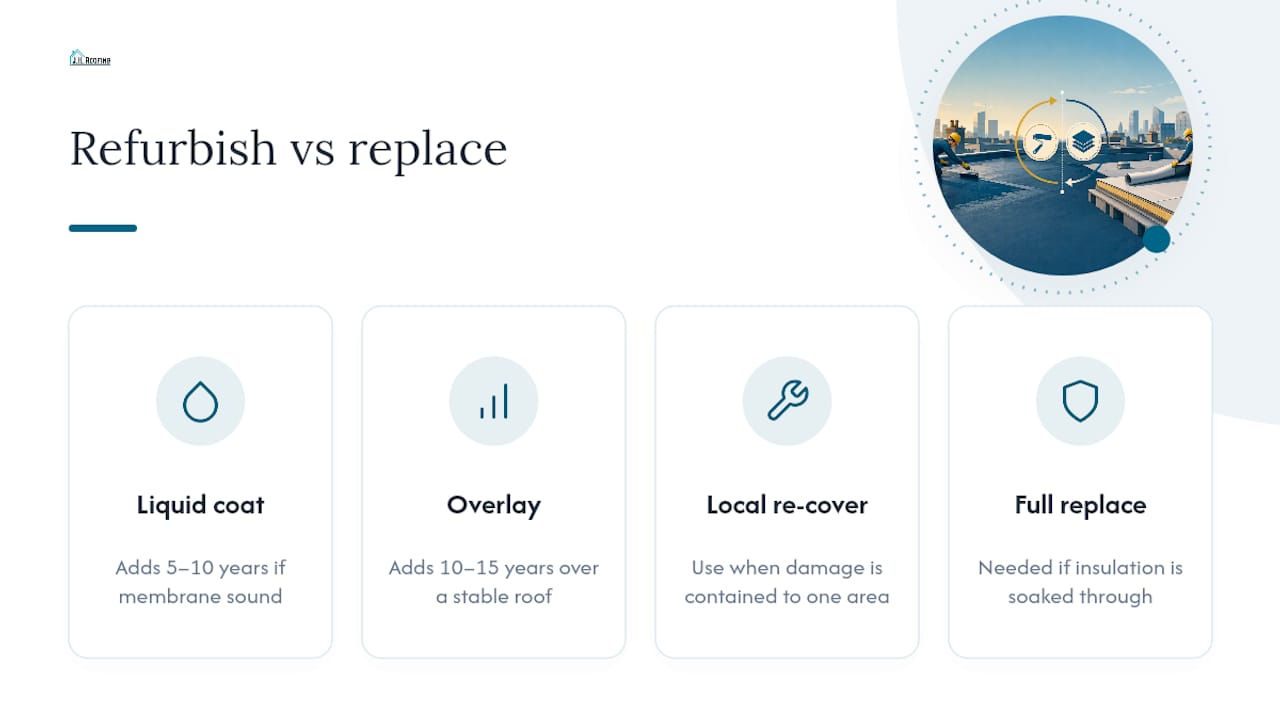
Local re-cover, replacing just the failing section rather than the whole roof, makes sense when damage is contained to one area, like around a single rooflight or parapet edge. Full strip-and-replace becomes the only sensible option once insulation is soaked through, since wet insulation loses its thermal performance and won't dry out on its own, a concern also flagged in government guidance on fuel and power conservation.
Cost drivers to expect: access difficulty (a rooftop with awkward scaffolding costs more to work on), how many penetrations and upstands need re-flashing, and whether you want a warranty that requires a specific installation standard.
A Real Kent Case Study: What Actually Determined This Roof's Lifespan
Jhroof's flat roof replacement in Kent is a good illustration of the pattern above. The original roof was showing ponding near a poorly detailed parapet junction, and years of standing water had gradually saturated the insulation beneath an otherwise serviceable membrane. Installation detailing, not the membrane's age alone, was the deciding factor in the replacement decision.
With over 10 years of experience across Kent, a 24-hour emergency response service, and a 4.7-star Google rating, Jhroof has seen this pattern repeat on plenty of roofs. If you're not sure whether your flat roof needs a repair, a refurbishment, or a full replacement, a free survey settles the question, or you can run the numbers yourself with the instant roof quote calculator.
The Maintenance Gap Nobody Talks About
Most advice on flat roof lifespan focuses on which membrane to buy, as if the product label is the deciding factor. It isn't. The research consistently points somewhere else: installation detailing and drainage explain most of the gap between a roof that fails at year 15 and one that's still going strong at year 30.
That's a slightly uncomfortable conclusion for homeowners, because it means the cheapest lever for a long-lasting roof isn't a premium material. It's an inspection twice a year and a willingness to fix a lifting seam the week you notice it, not the season after. Property managers juggling multiple buildings tend to skip this because it feels low priority next to bigger capital projects. That's backwards. A £200 reseal now is cheaper than a £6,000 insulation replacement in three years.
If you take one thing from this, prioritize the installer's detailing and your own inspection habit over agonizing between EPDM and PVC. Both will last decades if the basics are handled right.
— Gabbi
Get a Straight Answer on Your Flat Roof's Condition
Jhroof gives Kent homeowners and property managers something most national roofing chains can't: a local, family-run team that inspects your specific roof instead of quoting from a spreadsheet. Where guesswork about membrane age or drainage leaves you stuck between patching and replacing, Jhroof's free, no-obligation survey tells you exactly which category your roof falls into and what it will cost to fix.
Whether you're dealing with a ponding parapet like the one in our Kent case study, a membrane past its warranty, or just want a second opinion before committing to a full re-roof, Jhroof's team backs every job with insured workmanship and a 24-hour emergency response if something goes wrong before the work starts. Homeowners weighing a DIY fix should also know that flashing and junction work carries real risk of getting it wrong without the right tools and experience. Get a fast estimate with the roof quote calculator, or book a free survey directly with Jhroof today.
Sources
- Flat Roof Lifespan 2026: How Long Each Material Lasts | TRB
- Lead flashing alternatives: explaining the options | Marley
- Lead or Lead-Free Flashing? Differences and How to Choose | Eurocell
- Approved Document L (Conservation of fuel and power) | GOV.UK