
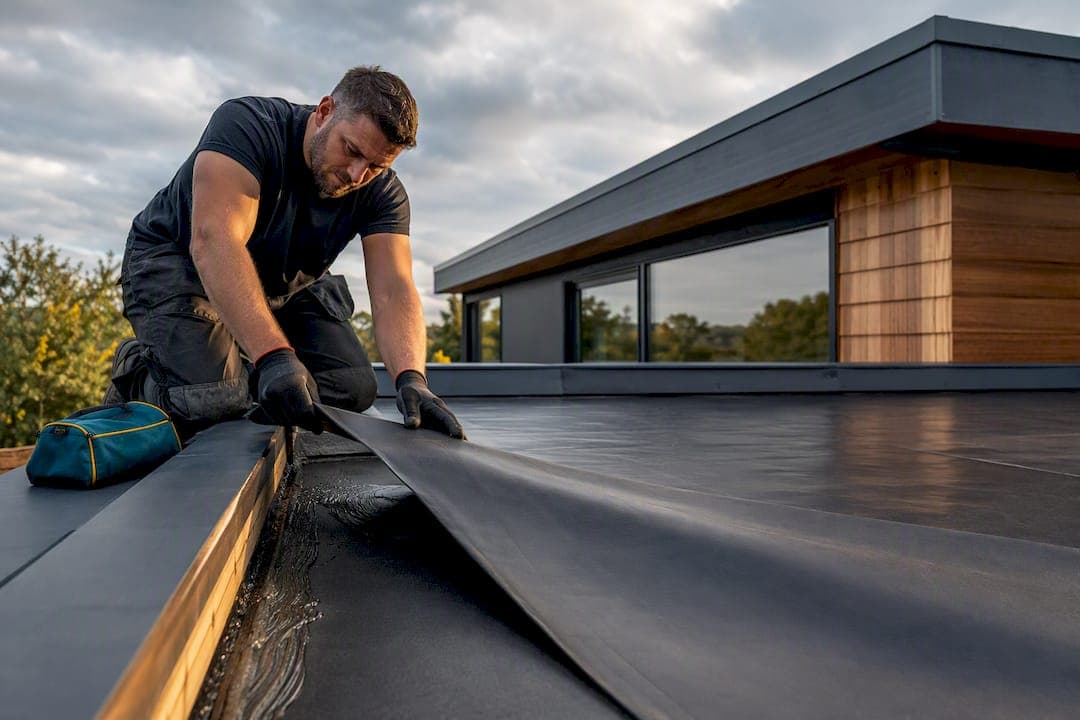
For most homes, the choice comes down to EPDM rubber or modified bitumen for value and simplicity, TPO or PVC for larger or newer flat roofs that need a longer-lived membrane, and GRP or green roofs for specialized jobs. Drainage and how you plan to use the roof, whether that's a quiet garage top or a terrace with solar panels, decide more of the outcome than the brand name on the membrane. What follows covers cost, lifespan, and the maintenance habits that keep any of these choices performing.
TL;DR:
- Proper drainage and a minimum slope of a quarter inch per foot are essential to prevent ponding and avoid premature membrane failure.
- EPDM is the most common residential flat roof material for simple shapes, offering decades of lifespan but requiring dry conditions for proper installation.
- Modified bitumen is budget-friendly with a typical lifespan of 10 to 12 years, but it involves fire risks during installation and shorter service life.
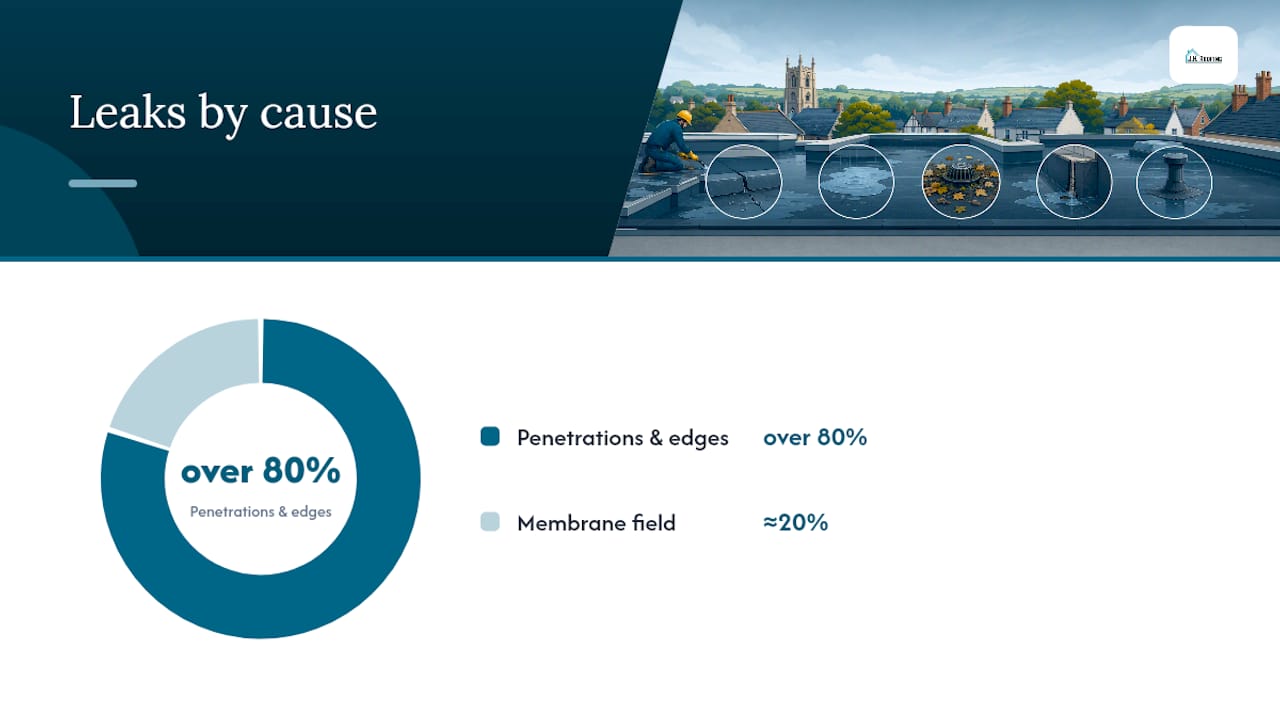
- Regular inspections focusing on flashing, seams, and drains are crucial, as over 80% of leaks originate from penetration and edge details.
- Choosing quality detailing, especially around junctions and drains, is more important than membrane brand when ensuring long-term roof performance.
Table of Contents
- Flat Roofing Systems Compared: Materials, Costs, and Lifespans
- How to Choose the Right Flat Roofing Option for Your Property
- Maintenance Schedule and Common Failure Points
- A Kent Flat Roof Replacement: What We Learned On Site
- What Twenty Years On Roofs Teaches You About Flat Roofing
- Get a Flat Roof Assessment From Jhroof
- Sources
Flat Roofing Systems Compared: Materials, Costs, and Lifespans
Every flat roofing material trades off differently between upfront cost, how long it lasts, and how forgiving it is during installation. Here's how the main options stack up.
EPDM (rubber membrane) is the workhorse of residential flat roofing. It's a single-ply synthetic rubber sheet, glued or mechanically fixed, and it's what most residential crews reach for on garages, dormer extensions, and small flat sections because it doesn't demand specialized welding gear the way TPO and PVC do, which keeps installation accessible and pricing competitive. Expect a lifespan of multiple decades, though installation has a catch: EPDM adhesives and seams need dry, mild conditions to bond properly, so a rushed job in wet or cold weather is a common source of early failure.
Modified bitumen (torch-on) is heated and fused in overlapping layers, giving a tough, waterproof surface at a lower material cost. It's popular on smaller residential jobs and flat roof repairs where budget matters more than longevity. The trade-off is a shorter working life, typically around 10 to 12 years, and the open flame used to torch the sheets down carries a genuine fire risk if the installer isn't careful around timber decking or old insulation.
TPO (thermoplastic polyolefin) is a heat-welded single-ply membrane that's gained ground on larger or newer flat roofs. Seams are fused with hot-air welding equipment rather than glued, which produces a stronger, more watertight joint, but it means you need a contractor carrying that kit. TPO tends to sit in the mid-to-upper cost bracket, reflecting the equipment and skill involved.
PVC shares TPO's welded-seam approach but adds better resistance to oils, fats, and chemical exposure, which matters if the roof sits near kitchen extraction vents or rooftop plant equipment. It's one of the longer-lived options, often quoted in the same 20 to 40 year range as EPDM, but installed cost runs higher.
GRP (fibreglass) is laid wet and cures into a rigid, seamless shell, which makes it the strongest choice for roofs with awkward shapes, upstands, or lots of penetrations, since there are no seams to detail around obstacles. It's a good fit for dormer tops and balconies but less common on large open expanses because of material cost at scale.
Green roofs layer a growing medium and vegetation over a waterproof membrane below. They cut heat gain and add insulation value, but they also add substantial weight, which means a structural assessment is non-negotiable before committing, along with an ongoing maintenance budget that can offset early savings.
Standing-seam metal shows up on premium or architecturally visible flat roofs where a metallic finish suits the building. It carries the highest installed cost of the common options but delivers excellent longevity and a distinctive look.
Cost and lifespan bands vary by material and roof size, but as a rule, torch-on sits at the budget end with the shortest service life, while EPDM and PVC deliver decades of service at a higher price point.
How to Choose the Right Flat Roofing Option for Your Property
Walk through these factors before you talk to a contractor, in roughly this order of importance:
- Drainage and slope. Every flat roof needs positive fall toward drains or scuppers, typically a minimum of about a quarter inch per foot, to avoid the ponding water that causes premature membrane failure. If your existing roof holds standing water 48 hours after rain, that's a design problem no membrane upgrade alone will fix.
- Roof size and shape. Simple rectangular roofs suit any membrane; complex shapes with upstands and dormers favor GRP or welded systems that handle detailing cleanly.
- Intended use. A roof carrying a garden terrace, solar array, or HVAC unit needs a membrane rated for foot traffic and point loads, plus extra flashing around every fixing.
- Budget versus whole-life cost. A cheaper torch-on job replaced twice in 25 years can cost more than one EPDM installation done right the first time.
- Visibility. A flat roof overlooked from upper windows or a terrace deserves a tidier finish than one tucked behind a parapet.
When you get quotes, ask each contractor: What's your warranty on seams and flashing, not just the membrane? How do you detail around existing penetrations? What's your installation window given the weather sensitivity of this material?
Three red flags: a quote with no mention of slope or drainage, a torch-on job proposed for a roof with multiple existing penetrations, and any contractor who can't describe how they'll flash the upstands.
Pro Tip: Ask your contractor to prioritize flashing details and fall to drains over the membrane brand. A premium membrane installed with lazy detailing will leak faster than a budget membrane installed with care.
Maintenance Schedule and Common Failure Points
Inspect your flat roof twice a year, spring and autumn, plus after any severe storm. Each check should cover:
- Drains and outlets clear of leaves, moss, and debris
- Flashing at walls, upstands, and roof edges still sealed and unlifted
- Any standing water still present more than two days after rain
- Seams and joints for cracking, blistering, or separation
Flashing and penetration details, not the open membrane field, cause most leaks. Industry guidance puts over 80% of flat roof leaks at penetrations and edge details rather than membrane failure itself, which is why a five-minute check around every pipe and vent matters more than staring at the middle of the roof.
Small blisters or a single lifted seam usually mean a patch repair. Widespread ponding, multiple failed seams, or a membrane past its expected lifespan point toward full replacement instead of another round of patching.
A Kent Flat Roof Replacement: What We Learned On Site
A local roofing company has over 10 years experience handling residential and commercial roofing across Kent, fully insured and with strong customer ratings built on jobs like this one.
- Scope: Full flat roof replacement on a rear extension where the original felt roof had failed at multiple upstand junctions.
- Material chosen: EPDM, selected for its long service life and because the roof's simple rectangular shape suited a single-piece membrane with minimal seams.
- Detailing focus: Rebuilt fall to a single outlet and reworked flashing at every wall junction, addressing the exact failure points the original felt had struggled with.
- Outcome: No ponding observed on follow-up inspection, with flashing details built to outlast the membrane itself.
Full project photos and specifics sit in the flat roof replacement case study, and you can get a rough sense of your own project cost with the Roof Quote Calculator.
What Twenty Years On Roofs Teaches You About Flat Roofing
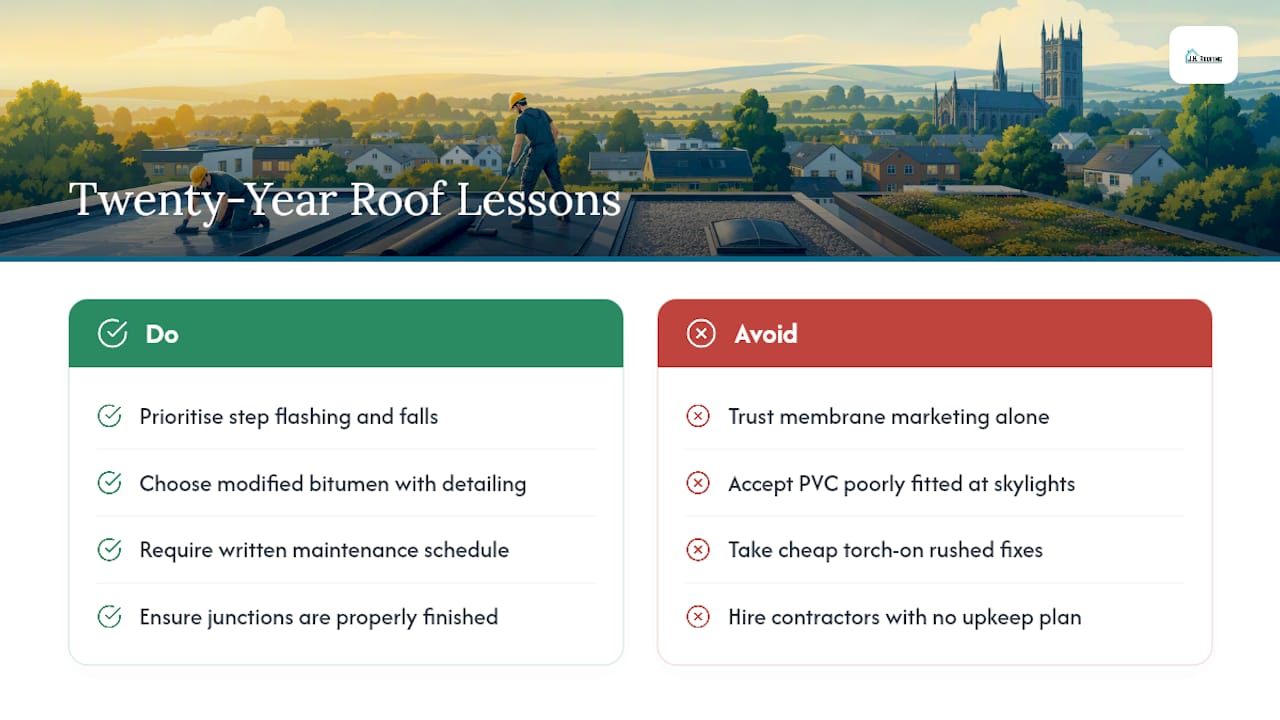
The membrane gets all the marketing attention, but step flashing and fall to drains decide whether a flat roof lasts ten years or thirty. I'd rather see a homeowner choose modified bitumen with excellent detailing than PVC installed carelessly around a skylight upstand.
Cheap torch-on fixes done in a rush, without proper attention to junctions, are the single most common callback we see. Ask for a written maintenance schedule up front. It tells you whether a contractor thinks about the roof after the invoice is paid.
— Gabbi
Get a Flat Roof Assessment From Jhroof
A flat roof that's detailed right the first time saves you the cost of doing it twice. Jhroof handles flat roof replacement, repairs, and 24-hour emergency response across Kent, backed by insurance cover and a track record documented in a Kent flat roof case study you can look at before you commit to anything.
If your roof is showing ponding, lifted flashing, or a membrane past its expected years of service, the practical next step is a proper look at what's actually happening up there, not a guess from ground level. Run your numbers through the Roof Quote Calculator for a free, no-obligation estimate, or browse the full range of roofing services in Kent if repairs or a full replacement are on the table. Jhroof's crews handle the flashing and drainage details that determine whether your new roof outlasts the last one.
Sources
- Flat roofs and skylights: design, flashing and installation guide | Build-Construct
- Residential flat roofs: material options & 2026 cost | The Roofing Brief
- 4 types of flat roofs: pros, cons, and costs | RoofSmart