
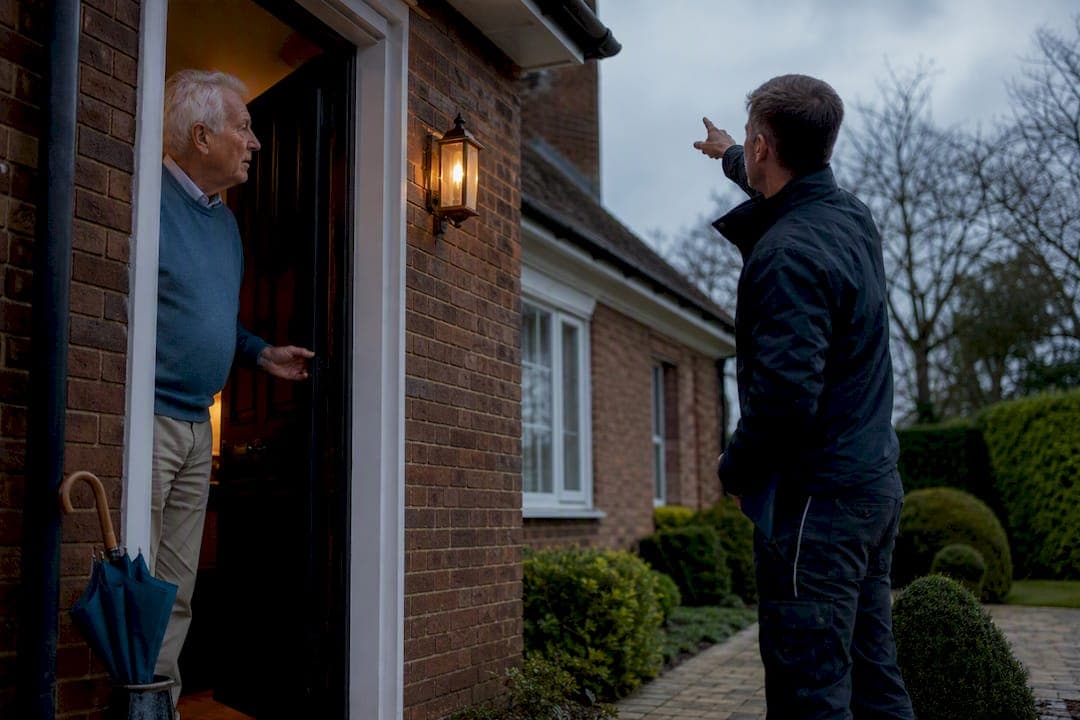
Roofing scams are common across the UK, and most start with an unsolicited knock at the door. If someone turns up unannounced offering to check your roof, do not let them climb up, do not hand over cash, and close the door. If money has already changed hands, contact your bank, then Trading Standards through Citizens Advice or Action Fraud.
TL;DR:
- Most roofing scams start with unsolicited door-to-door offers, and genuine tradespeople rarely insist on starting work immediately.
- Pressure tactics, demands for cash upfront, and significant price increases after work begins are key warning signs of a scam.
- Always obtain multiple written quotes, verify company registration on Companies House, and check for insurance before hiring a roofer.
- Report any suspected scam to your bank, Citizens Advice, and Action Fraud within hours to prevent further losses.
- Reputable roofing projects typically take days or weeks, not hours, and high prices should align with work scope, not sudden inflated invoices.
Table of Contents
- What Are the Most Common Roofing Scams in the UK?
- How Can You Tell a Dodgy Roofer?
- How to Avoid Roofing Scams: A Step-by-Step Checklist
- What to Do If You've Been Scammed by a Roofer
- How to Choose a Reputable Roofer
- Local Evidence and Official Warnings on Roofing Fraud
- How Long Does a Legitimate Roofing Project Take?
- What Should Typical UK Roofing Repairs Actually Cost?
- A Note From J.H. Roofing on Protecting Your Home
- Sources
- FAQ
What Are the Most Common Roofing Scams in the UK?
Roofing con artists in the UK tend to recycle the same handful of tricks because they work. Recognizing the pattern matters more than memorizing every variation.
The classic opener is the doorstep cold call.
Once a trader is on your roof, a few things tend to happen:
- Ladder theater, where a trader photographs, exaggerates, or deliberately causes minor damage to justify a much bigger job than you actually need.
- The disappearing roofer, who takes a deposit, does a fraction of the promised work, then vanishes or stops answering calls.
- Escalating extras, where the quoted price balloons once scaffolding is up and you feel you have no choice but to keep paying.
- Insurance cheque collectors, who offer to "deal with your insurer directly" and then intercept or redirect the payout.
- Fake identity fraud, where criminals borrow a real, reputable company's name and paperwork to look legitimate, a tactic BBC News documented in reporting on victims who paid tens of thousands of pounds for unnecessary work.
The common thread across nearly all of these is speed. Legitimate roofing work almost never needs to start the same day, and pressure to skip that gap is the clearest sign something is wrong.
How Can You Tell a Dodgy Roofer?
Most roofing con artists give themselves away within the first few minutes if you know what to watch for.
Pressure is the biggest tell. A trader who insists you decide "right now," who won't leave until you agree, or who claims the price is "only good today" is running a script, not offering a genuine quote. Genuine tradespeople expect you to compare quotes and take your time.
Payment demands are the second giveaway. Watch for these signs together, since one alone might have an innocent explanation, but several at once almost never do:
- Insistence on cash, or a large deposit before any work has started.
- No written contract, no company address, and no landline, just a mobile number.
- Paperwork that does not match, such as invoices under one name and a van signwritten with another.
- A quoted price that jumps once the scaffolding goes up or the ladder comes down.
- Refusal to show public liability insurance, provide references, or let you see an ID badge.
- Vans or equipment parked in a way that blocks your driveway or exit.
Pro Tip: Ask for the company's full trading name and a landline number, then hang up and look the business up independently on Companies House before calling back. A legitimate roofer will never mind the delay.
Trading Standards teams across England and Scotland have repeatedly warned households not to engage with unsolicited doorstep traders at all, regardless of how convincing the pitch sounds.
How to Avoid Roofing Scams: A Step-by-Step Checklist
Avoiding roofing scams in the UK comes down to slowing the process down enough that a con artist loses interest and moves to an easier target. Here's the order to work through:
- Say no to any doorstep offer, even a free inspection. Tell them to leave a number and you will call if interested. Most scammers won't bother leaving one.
- Get at least three written quotes from separate companies before agreeing to anything, especially for work over a few hundred pounds.
- Check the company on Companies House for a registered address and trading history, and search their name plus "reviews" or "complaints."
- Look for a Trading Standards vetted-trader scheme, such as local "Buy With Confidence" style directories, which vet insurance and trading history before listing a firm.
- Ask for two or three references from recent local jobs and actually call them.
- Insist on a written contract before any work starts, covering the full scope, materials, a staged payment schedule, and your legal cancellation rights.
- If the roof is leaking urgently, ask for a temporary tarpaulin and get an independent inspection before committing to major works.
Citizens Advice figures put roofing and chimney repairs as the largest single category of home improvement complaints it handles, accounting for over one in five such complaints, and roughly 14% of all home improvement complaints involve scams or rogue traders outright. That scale is exactly why the multi-quote habit matters more for roofing than for almost any other home repair.
If you signed anything away from a business premises, such as at your own front door, you likely have a 14-day cooling-off period to cancel without penalty. Rogue traders push to start work immediately specifically to make that right harder to use.
What to Do If You've Been Scammed by a Roofer
If you suspect you've paid a roofing scammer, or work has stopped and no one is answering, act within hours rather than days.
- Stop any further payments immediately and call your bank's fraud team. In the UK, dial 159 to reach your bank's verified fraud line through Stop Scams UK.
- Document everything you can: photos of the roof, copies of invoices, the trader's name and any vehicle registration, and any texts, calls, or messages exchanged.
- Contact Citizens Advice on 0808 223 1133. Its consumer service can escalate your case to Trading Standards on your behalf and advise on your legal rights to a repair or refund.
- Report suspected fraud to Action Fraud or your local police if you believe a crime, rather than just poor workmanship, has occurred.
- Get an independent roofing survey and written quotations for any remedial work before paying anyone else, so you know the true scope of the damage.
Recovery routes vary by how you paid. A card payment may qualify for a chargeback through your card issuer, a bank transfer may be disputed directly with your bank, and unnecessary work billed through an insurance claim can sometimes be challenged with your insurer. Citizens Advice guidance on faulty home improvements sets out your right to ask for a repair or refund even after the fact, and a second opinion from a company offering fast, insured roof repairs can confirm exactly what genuine repair work should cost.
How to Choose a Reputable Roofer
Picking the right contractor the first time removes most of the risk entirely. Before you sign anything, confirm a few basics.
A proper written quote should spell out the full scope of work, the materials being used, a realistic timeline, any guarantee on workmanship, and clear cancellation terms. If a quote is a single vague paragraph with a total at the bottom, ask for more detail before agreeing to anything.
Verify the business itself separately from what the quote says. Check for a Companies House registration, a permanent trading address rather than just a mobile number, genuine public reviews rather than a handful of recent five-star ratings, and membership in a recognized trade body. One useful habit borrowed from wider home improvement vetting: a contractor-checking approach that confirms insurance and workmanship standards before any deposit changes hands applies just as well to roofing as it does to other trades.
Always ask to see current public liability and employer's liability insurance certificates, and note the policy numbers rather than just glancing at the document.
- Request references from at least two recent local jobs, not just testimonials on their website.
- Agree a staged payment schedule tied to completed milestones, never a lump sum upfront.
- Withhold the final payment until you have personally inspected the finished work.
Pro Tip: A reputable roofer will never object to you calling their insurer to confirm the policy is active. If they hesitate or change the subject, it may indicate an issue.
Local Evidence and Official Warnings on Roofing Fraud
UK prosecutions show the scale of organized roofing fraud. A 22-person network extracted more than £1 million from homeowners, with ringleaders receiving a combined 63 years in prison. Devon and Aberdeenshire councils have issued similar Trading Standards alerts urging residents to avoid unsolicited doorstep traders entirely.
| Protective measure | What it does |
|---|---|
| "No cold calling" door sticker | Signals to traders that unsolicited visits are refused |
| Call blocker or screening app | Filters unknown numbers before they reach a vulnerable relative |
| Doorbell camera | Records visitors and vehicle details for later reports |
| Vetted-trader scheme | Confirms insurance and trading history before a first visit |
How Long Does a Legitimate Roofing Project Take?
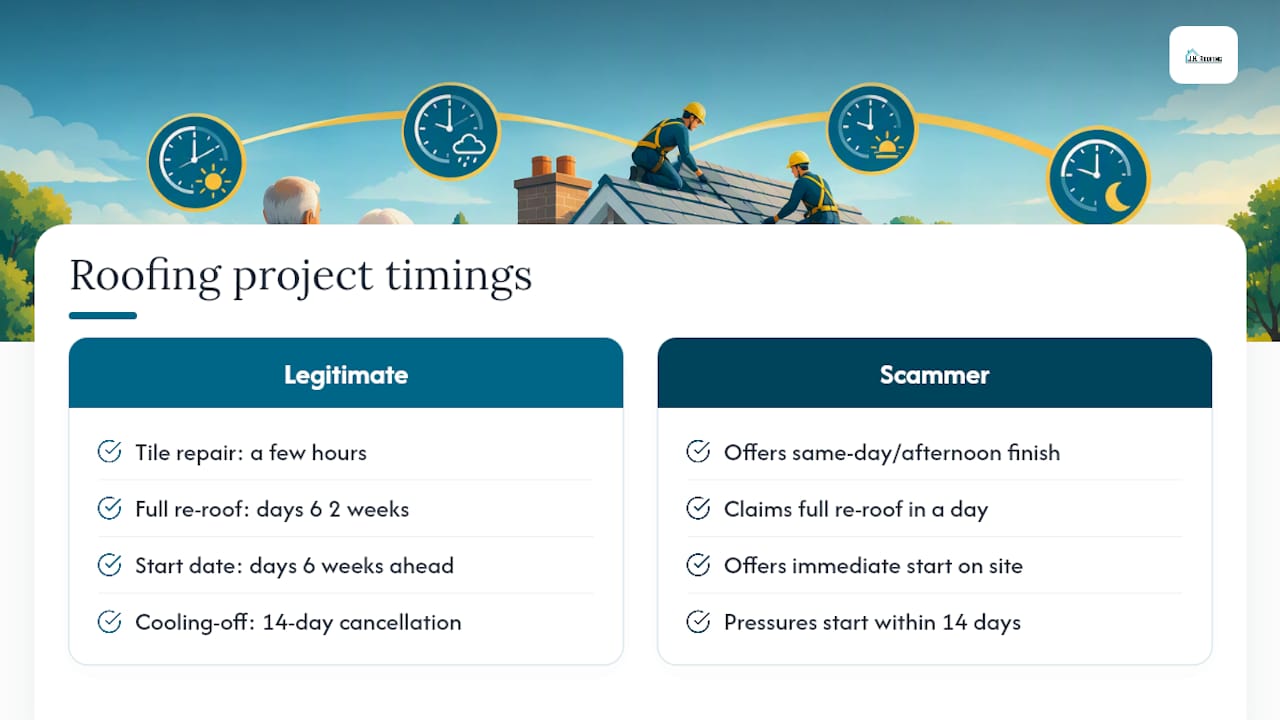
A straightforward tile repair typically takes a single visit, often just a few hours from arrival to a finished job. A full roof replacement on an average semi-detached home usually runs from a few days to around two weeks once scaffolding, materials, and weather are factored in, and a reputable company will tell you that upfront rather than promising a same-day full re-roof.
Scammers exploit the gap between a quote and the actual work by compressing that timeline artificially. If someone offers to start "right now" on a job that would normally take days to schedule, or insists a full re-roof can be finished in an afternoon, that speed is the warning sign, not a selling point. Legitimate roofers need time to order the correct materials, book scaffolding if required, and check weather windows, so a firm quote almost always includes a start date days or weeks out, not an immediate slot.
The other timing trick is urgency around cooling-off rights. Anyone who signs a contract at their own front door has a 14-day window to cancel without penalty. A trader who insists on starting work within that window, especially before you've had time to get a second quote, is often trying to make cancellation practically impossible once the roof is already stripped bare.
What Should Typical UK Roofing Repairs Actually Cost?
Prices vary by region and roof type, but wildly inflated quotes are one of the easiest scam signals to catch once you know a rough baseline. A single tile repair on a pitched roof is a small, quick job, reflected in entry-level pricing that starts from a typical amount for a straightforward one-off fix.
Larger jobs scale accordingly: a full roof replacement on an average UK home is a major undertaking involving materials, scaffolding, and skilled labor across several days, so it sits at a different price tier entirely from a same-day tile repair. Flat roof work, chimney and leadwork repairs, and guttering or fascia replacement each carry their own separate costs depending on materials and access.
The scam pattern to watch for isn't a high price on its own, since quality roofing work genuinely costs money. It's a price that jumps sharply between the initial doorstep pitch and the invoice once work has already started, with no clear explanation of what changed. Getting a written quote for roof replacement work before any scaffolding goes up gives you a fixed number to hold a contractor to, rather than a moving target.
A Note From J.H. Roofing on Protecting Your Home
If you've been targeted, report it through official channels first. That said, we offer free, no-obligation quotes and 24-hour emergency support across Kent, and we always encourage checking any roofer against a vetted scheme before work begins.
— Gabbi
This article is general information, not a substitute for advice from a qualified financial advisor. Consult a qualified financial professional about your own circumstances before acting on anything here.
Sources
- 63 years’ jail time for gang behind £1m fraud investigated by York team – City of York Council
- Trading Standards alert: Roofing crime warning - Avoid unsolicited doorstep traders – London Borough of Bromley
- Shoddy tradeswork is sparking more than 700 complaints a week, says Citizens Advice
- Scammed by rogue roofers: 'I felt trapped' - BBC News
FAQ
How Can You Tell a Dodgy Roofer?
Watch for pressure to decide immediately, demands for cash or a large deposit, no written contract, and a mobile-only number with no fixed business address. A price that jumps once work has started is one of the clearest signs of a rogue trader.
What Are Some of the Most Common Roofing Scams Right Now?
Current tactics include doorstep cold calls claiming urgent damage, staged "ladder theater" to exaggerate a repair, disappearing roofers after a deposit, insurance cheque interception, and criminals borrowing a legitimate company's identity to look trustworthy.
What Should I Do if I've Been Scammed by a Roofer?
Stop any further payments and call your bank's fraud line on 159 immediately. Document everything, then report the case to Citizens Advice on 0808 223 1133 and to Action Fraud if you suspect criminal activity.
Are Roofing Scams Common in the UK?
Yes. Roofing and chimney repairs make up the largest category of home improvement complaints Citizens Advice handles, and around 14% of those complaints involve scams or rogue traders specifically.
Do I Have the Right to Cancel a Contract Signed at My Door?
In most cases, yes. Contracts agreed away from a business premises, including at your front door, usually carry a 14-day cooling-off period, and any trader pushing you to start work sooner is trying to bypass that right.