
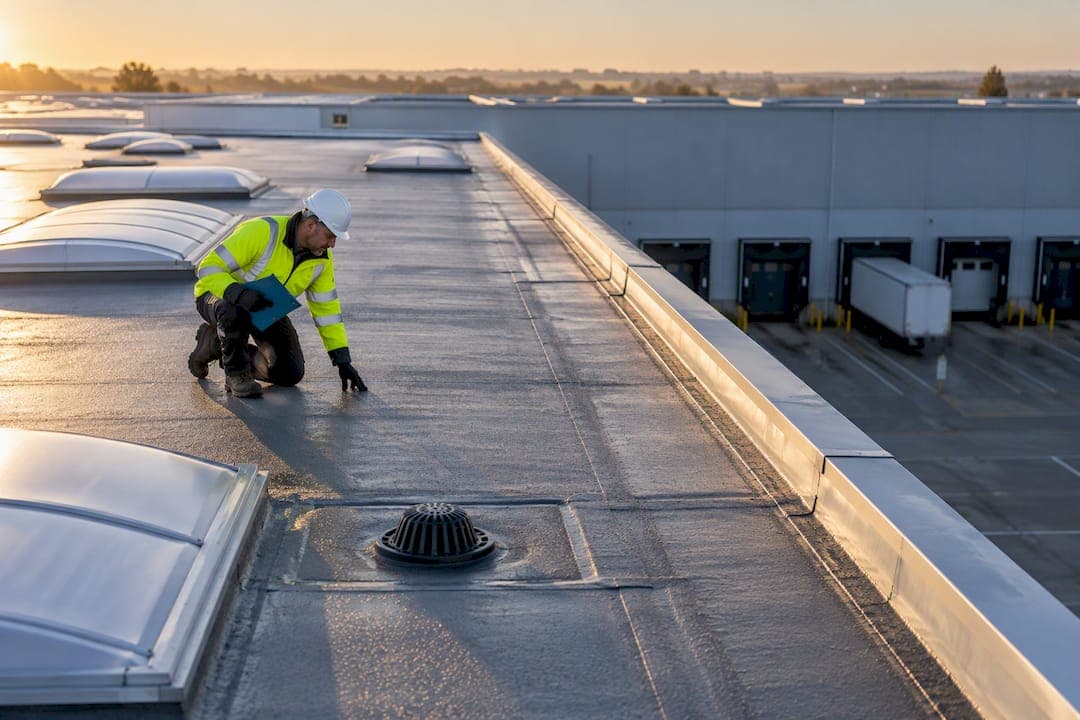
Inspect your warehouse roof visually every week, bring in a contractor for a formal survey once a year, and schedule a specialist moisture or intrusive check every 3 to 5 years depending on the roof's age and construction. Above everything else, keep water moving: clear drains, clear gutters, and stop ponding before it starts. If you spot standing water or an active leak during your walkaround, log it and call a contractor the same day.
TL;DR:
- Routine inspections should focus on drainage outlets, roof ponding, penetrations, membrane seams, and rooflights to catch issues early and prevent costly damage.
- Temporary fixes for ponding, membrane splits, or fragile rooflights can be made safely, but all major repairs require professional contractor intervention.
- Document all inspections and repairs meticulously through photos, logs, and reports to support warranties, insurance claims, and dispute resolution.
- Roof inspections should occur weekly by in-house staff, annually by a contractor, and specialist surveys every 3 to 5 years, especially for older roofs nearing end of warranty.
- Always require a written risk assessment, method statement, and proof of insurance from contractors, and avoid sending untrained personnel onto fragile or complex roof surfaces.
Table of Contents
- Why Maintenance Matters: Business Risk, Lifespan, and Cost Avoidance
- Inspection Cadence Explained and a Zone-Based Checklist You Can Use
- Common Warehouse Roof Defects and Safe Short-Term Fixes
- Safety Rules for Roof Work and Practical Controls
- A Simple Planned Preventative Maintenance Program You Can Implement
- Recording Inspections and Repairs to Protect Warranties and Insurance Claims
- When to Involve a Roofing Contractor and a Brief Contractor Scope Checklist
- Lessons From the Field: What Actually Prevents Roof Failures
- Get a Free Quote or Emergency Roof Support From J.H. Roofing
- Key Guidance and Authoritative Resources
- Sources
- FAQ
Why Maintenance Matters: Business Risk, Lifespan, and Cost Avoidance
A blocked outlet rarely stays a small problem. Water backs up, finds a seam or a fastener, and within a season you're looking at soaked insulation, a stained ceiling over racked stock, and a repair bill that's grown well past what a gutter clearance would have cost. Warehouses compound this risk because the roof sits over stock, machinery, and sometimes live electrical plant, so a leak is never just a leak.

Planned maintenance works because it catches these problems while they're still cheap to fix. A cracked flashing found on a routine check is a small job. The same flashing failure discovered after it has soaked through insulation and dripped onto a pallet of goods is a much bigger one, and it may also trigger a business interruption claim you'd rather avoid filing.
Lease and insurance exposure adds another layer. Facility managers can end up disputing who is responsible for a leaking roof, and lease wording often decides that argument, particularly around "wind and watertight" clauses. Getting ahead of maintenance protects you on both fronts.
- Small defects like a cracked flashing or a slow drain escalate into insulation damage, stock loss, and structural repairs.
- Routine maintenance is consistently cheaper than emergency recovery or full replacement.
- Lease and warranty terms often hinge on whether you can show a documented maintenance history.
Inspection Cadence Explained and a Zone-Based Checklist You Can Use
The right inspection frequency depends on the roof, but the pattern that works for most warehouses is layered: quick visual checks by your own team, a formal annual survey by a contractor, and periodic specialist testing on a longer cycle. Industry guidance commonly points to that annual contractor inspection plus a specialist intrusive or moisture survey every 3 to 5 years, with the shorter end of that range applying to older roofs or those nearing the end of their warranty.
- Weekly visual walkaround. Have on-site staff check for obvious ponding, debris on the roof surface, and anything that looks different from the previous check.
- Annual contractor survey. Bring in a roofing professional once a year to check membrane condition, flashings, and fixings up close.
- Specialist survey every 3 to 5 years. Moisture mapping or infrared surveys catch trapped water in the insulation before it shows up as a ceiling stain, and RICS guidance on planned preventative maintenance recommends building these into a multi-year PPM programme rather than treating them as one-off events.
Organize what you're checking by zone rather than trying to inspect the whole roof as one undifferentiated surface:
- Drainage: outlets, gutters, and scuppers clear of leaves, moss, and debris.
- Falls and ponding: water sitting more than briefly after rain, especially near low points.
- Rooflights: cracking, discoloration, or crazing in the panel.
- Penetrations: seals around HVAC units, cable runs, and pipework.
- Membrane seams and flashings: lifting, blistering, or gaps at joints and upstands.
- Plant fixings and walkways: loose fittings and worn pedestrian protection near roof-mounted equipment.
Certain findings should move you from "note it and monitor" to "call someone now": ponding that lasts more than 48 hours, any leak near electrical plant, or a repair that keeps recurring in the same spot. Repeat failures at one drain usually mean a falls problem in the deck, not a defective drain, and patching it again just delays the real fix.
Pro Tip: Keep a simple roof zone map with each drain and rooflight numbered, so every inspection report refers to the same locations and you can spot a pattern over time.

Common Warehouse Roof Defects and Safe Short-Term Fixes
Most warehouse roof problems fall into a handful of categories, and knowing which ones you can safely manage until a contractor arrives, versus which need immediate professional attention, saves both money and risk.
- Ponding water: Clear any visible debris from the nearest outlet from a safe access point. If ponding persists after the drain is clear, the issue is likely the roof's falls, which means structural attention rather than a quick fix.
- Blocked outlets and gutters: Clear from ground level or a properly certified access platform. Never lean over a parapet or use an unsecured ladder to reach a gutter.
- Membrane damage: A small split can often take a temporary compatible patch to stop water ingress, but treat this as a holding measure. Full recovery or a proper repair should follow, not replace it indefinitely.
- Fragile rooflights: Never step on or near a rooflight to inspect it. Use binoculars, a drone survey, or a mobile elevating work platform to check condition from a safe distance.
- Damaged flashings and penetrations: A temporary sealant application can buy time, but monitor it closely and schedule permanent flashing replacement, since sealant alone won't hold through a full season of weather.
Safety Rules for Roof Work and Practical Controls
Roof work is one of the most dangerous tasks a facility manager will ever authorize, and the rules exist because the risk is real, not theoretical. HSE guidance on roof work notes that falls through fragile rooflights and fragile materials account for a large share of serious injuries and deaths on roofs, and even short-duration maintenance or cleaning tasks require a proper risk assessment before anyone goes up.
According to HSE's guidance for building owners and managing agents, an average number of people die each year falling through fragile roofs or rooflights. That figure is the reason the default assumption should always be that a roof is fragile until someone with the right competence certifies otherwise.
The practical response is to plan the work properly and avoid putting untrained people on the roof at all where you can help it:
- Treat any roof as fragile unless a competent surveyor has confirmed otherwise in writing.
- Require a written risk assessment and method statement before any contractor sets foot on the roof.
- Insist on trained, competent personnel, not general laborers, for any roof access work.
- Use a mobile elevating work platform or netting instead of walking the roof surface where safe working practices for fragile roofs allow it.
- Send drones or use MEWPs for routine visual checks rather than sending your own staff onto the roof deck.
Insist your contractors bring the same discipline. A roofer who cannot produce a method statement or talk you through their access plan before starting work is a red flag, not a formality you can skip.
A Simple Planned Preventative Maintenance Program You Can Implement
A PPM program doesn't need to be complicated to work. It needs to run on a loop you actually follow: inspect, record, prioritize, fix, and verify, then repeat on schedule.
- Inspect each zone on the cadence set out above, weekly visual checks plus the annual contractor survey.
- Record every finding with a photo, a location tag, and a date, even when the issue looks minor.
- Prioritize by criticality: drainage-related issues and anything near electrical plant jump to the top, cosmetic wear waits.
- Fix the highest-priority items first, using temporary measures only as a bridge to a permanent repair.
- Verify the fix at the next inspection cycle and close out the record.
Mapping your roof into zones makes the prioritizing step much easier. Drainage-first zones, meaning anything within a few meters of an outlet or scupper, deserve the tightest attention because that's where deterioration usually starts. Plant zones around HVAC units and roof-mounted equipment come next, since fixings and seals there fail under vibration and thermal cycling.
PPM also forces a useful budgeting question: at what point does another patch stop making sense? A membrane that needs its third repair in the same area within two years is usually telling you it's due for recovery or replacement, not another patch. RICS guidance on planned preventative maintenance recommends building programs around 5 to 10 year maintenance periods precisely so these life-cycle decisions get made on evidence rather than guesswork, and a documented PPM history also makes contractor procurement and warranty renewals considerably smoother.
Recording Inspections and Repairs to Protect Warranties and Insurance Claims
A repair that isn't documented is, for warranty and insurance purposes, a repair that didn't happen. Manufacturer warranties and insurance claims both depend on being able to show what was found, what was done, and when.
- Take dated, location-tagged photos at every inspection, not just when there's a visible problem.
- Keep inspection logs, method statements, and contractor invoices together in one place.
- Retain tester or survey reports for the life of the warranty period, not just the year they were produced.
- Use a consistent digital folder structure by zone and date, backed up off-site, so records survive a hardware failure.
Missing documentation is one of the most common reasons warranty claims get rejected. When you can hand an insurer or a manufacturer a clear timeline of inspections and repairs, disputes tend to resolve much faster.
When to Involve a Roofing Contractor and a Brief Contractor Scope Checklist
Some tasks are squarely contractor territory: fragile roof access, intrusive moisture testing, major membrane recoveries, and anything involving scaffolding or edge protection. Trying to handle these in-house is both a safety risk and, often, a warranty violation.
When vetting a contractor, ask about their public liability insurance, request a written method statement, and ask specifically about their experience with warehouse or industrial roofs rather than domestic work. A solid scope of work should cover access arrangements, any temporary works needed, moisture or membrane testing, warranty terms on the finished work, and handover paperwork you can file alongside your maintenance records.
J.H. Roofing carries out roof repairs and maintenance alongside emergency call-outs for active leaks, and their fast repair service is worth knowing about before you need it, not after.
- Confirm public liability insurance and ask to see the certificate.
- Request a written method statement and risk assessment before work starts.
- Ask about warehouse or industrial roofing experience specifically.
- Get warranty terms and handover documentation in writing as part of the scope.
Pro Tip: Ask any contractor how they plan to access rooflights and fragile areas before they quote. A contractor who hasn't thought about it yet probably hasn't thought about your roof.
Lessons From the Field: What Actually Prevents Roof Failures
The roofs that fail early almost always share the same story: someone kept patching the same spot instead of asking why it kept failing, and nobody wrote any of it down. Drainage gets treated as an afterthought until the ceiling stains, and by then the fix costs multiples of what a gutter clearance would have.
The facility managers who avoid this do a few unglamorous things consistently: a five-minute weekly visual check, drains cleared on a fixed schedule rather than "when someone notices," and a phone full of dated photos instead of a vague memory of "we looked at that last year." None of it requires special equipment. It requires not skipping the boring parts, and knowing when a job is beyond a temporary fix and needs a properly insured contractor with the right access equipment.
— Gabbi
Get a Free Quote or Emergency Roof Support From J.H. Roofing
Running a maintenance program in-house still means you'll need a contractor for the jobs that require proper access equipment, insured labor, and warranty-backed materials. J.H. Roofing covers flat roof repairs, leak diagnosis, drone surveys for fragile or hard-to-access roofs, and ongoing maintenance work across the range your warehouse is likely to need.
- Request a free, no-obligation quote for a repair, survey, or maintenance plan.
- Call on the 24-hour emergency repair line if you're dealing with an active leak right now.
- Ask about flat roof replacement and recovery options if your roof is past the point where patching makes sense.
A family-owned, insured roofing company with strong customer ratings treats every warehouse roof with the same care as the smallest domestic repair. Get in touch for a free quote and find out where your roof stands.
Key Guidance and Authoritative Resources
- HSE roof work guidance (HSG33) and fragile roof safety practices (GEIS5).
- RICS planned preventative maintenance guidance.
- Field photo workflows from Sub Ascent's documentation guide support the record-keeping practices above.
Sources
- Health and safety in roof work (HSG33, Fifth Edition)
- Fragile roofs: Safe working practices (GEIS5)
- RICS: Planned preventative maintenance (PPM) guidance
FAQ
What maintenance should be done on a roof?
Regular maintenance means clearing drains, gutters, and outlets, checking rooflights and flashings for damage, and fixing small defects before they spread. A weekly visual check plus an annual professional survey covers most warehouse roofs, with specialist moisture testing every few years depending on the roof's age.
Are commercial tenants responsible for roof repairs?
Responsibility depends entirely on the lease wording, particularly clauses about keeping the property "wind and watertight." Recent court decisions show these clauses get interpreted closely, so check your lease and Schedule of Condition rather than assuming either party carries the obligation by default.
How to tell a dodgy roofer?
A contractor who won't provide proof of public liability insurance, can't produce a written method statement, or refuses to give a firm quote before starting work is worth avoiding. Ask about their experience with warehouse or industrial roofs specifically, since domestic roofing experience doesn't always translate.
How much should a roofer charge per day?
Roofing costs vary widely by job type, region, and materials, so there's no single day rate that applies across the board. A single tile repair can start from £150 as a one-off job, while larger jobs like replacements are quoted individually after a site visit.