
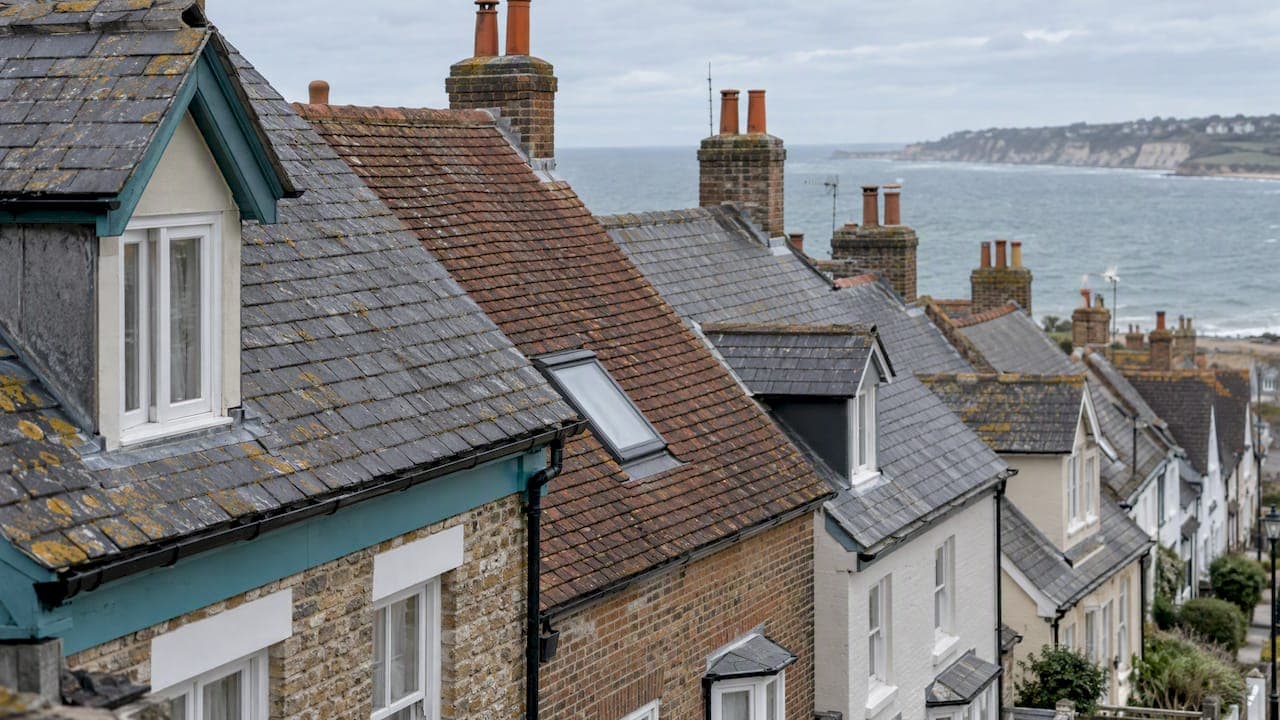
For pitched coastal roofs, natural slate or a high-quality concrete interlocking tile such as the Marley Edgemere gives the best balance of longevity and looks. For flat roofs, a BBA-certified GRP system like Polyroof's 185 GRP System handles salt-laden weather well. Neither choice matters much, though, without the right corrosion-resistant fixings and a vapour-permeable underlay behind it. Read on for the detail, or ask a local roofer for a site survey before you commit.
TL;DR:
- Near open coast, use grade 316 stainless steel for ridge, hip, and solar fixings; farther inland, galvanized steel may suffice after a site survey.
- Polyroof’s 185 GRP System has a certified minimum lifespan of 25 years and allows foot traffic within 30 to 60 minutes, with proper deck preparation.
- Inspect fasteners, flashings, and sealants at least twice yearly, and check flat roofs for moss, standing water, and blisters before small defects become leaks.
- Most roof replacements using matching materials avoid planning permission, but listed buildings and conservation areas may require consent or restrict visible changes.
Table of Contents
- Which roofing materials suit coastal homes best?
- A closer look at each coastal roofing material
- Fixings, underlays, and flashings for salt exposure
- How distance from the sea should shape your spec
- Installation and maintenance that protect your investment
- What local roofing experience tells us about coastal specs
- Environmental impact and sustainability of coastal roofing materials
- Comparing costs: upfront price against lifetime value
- Keeping coastal roofs in character with their surroundings
- Building regulations and planning rules along the Kent coast
- What actually determines how long a coastal roof lasts
- Get your coastal roof assessed by a local Kent roofer
- FAQ
- Sources
Which roofing materials suit coastal homes best?
Salt-laden wind and driving rain do not treat every roof covering the same way. A material that performs well 20 miles inland can fail years early once it sits within sight of the sea, and the gap usually comes down to corrosion resistance rather than the material's headline durability rating.
For most Kent coastal properties, the shortlist looks like this:
- Pitched roofs: natural slate or a quality concrete interlocking tile, such as the Marley Edgemere, fitted with full mechanical fixing rather than relying on friction or adhesive alone.
- Flat roofs: GRP systems like the 185 GRP System, or a correctly specified single-ply membrane where the roof geometry and ventilation needs suit it.
- Fixings and accessories: hot-dip galvanized or aluminum fasteners for general pitched work, stepping up to grade 316 stainless steel for ridges, hips, and anything holding solar equipment.
None of these choices works in isolation. A premium tile fixed with the wrong fastener, or a flat roof system laid over a poorly prepared deck, will still let you down well before its rated lifespan.
A closer look at each coastal roofing material
Each material on the shortlist earns its place for different reasons, and the right pick depends on your roof's pitch, your property's style, and how exposed your location is.
Natural slate remains the benchmark for period and higher-spec coastal homes. Welsh and Spanish slates handle salt spray well and can last well beyond a century when properly fixed. On exposed sites, slate nails alone are often not enough; many coastal installations call for slate and tile clips at the eaves, verges, and exposed hips to resist wind uplift.
- Marley Edgemere concrete interlocking tiles give a slate-like appearance at a lower cost, with a covering capacity of 9.7 tiles per square meter and compatibility down to a 17.5-degree pitch when installed with the correct headlamp. Because the tile is part of a wider Marley system, pairing it with matching dry-fix ridge and verge components keeps the whole roof compliant with BS 5534 wind-uplift guidance and backed by the manufacturer's 15-year system guarantee.
- Metal roofing, including aluminum and Galvalume-coated steel, works well on garages, extensions, and some contemporary coastal builds. Aluminum tolerates salt air better than coated steel, and we generally steer clients away from painted steel within the first mile of open coastline, where coating breakdown accelerates.
- GRP flat roofing, such as the 185 GRP System, is BBA-certified with a certified lifespan of at least 25 years and can typically be walked on just 30 to 60 minutes after application. That quick cure time matters on coastal jobs where a weather window can close fast. Correct deck preparation is non-negotiable here; a poorly primed substrate is the most common reason GRP fails early.
- Single-ply membranes suit larger, simpler flat roof areas and some warm-roof builds, but they need careful attention to vapor control and venting detail, which our case study on flat roof replacement in Kent illustrates on a recent domestic project.
Fixings, underlays, and flashings for salt exposure
The parts of a coastal roof you never see decide how long it lasts. Fastener corrosion is the single most common point of long-term failure in UK coastal roofs, and it is also the cheapest problem to prevent at the point of specification.
- Use hot-dip galvanized steel or aluminum fixings as the baseline for pitched roofs in coastal areas.
- Step up to grade 316 stainless steel for solar panel brackets, ridge fixings, and hip fixings, where corrosion would be hardest to spot and most expensive to fix.
- Specify a vapor-permeable underlay, such as Roofshield, which carries a vapor resistance and Sd-value that make it suitable for non-ventilated cold roof designs common in coastal extensions, according to manufacturer data, suitable for non-ventilated cold roof designs common in coastal extensions.
- Avoid mixing dissimilar metals directly against each other, since galvanic corrosion between, say, aluminum flashing and untreated steel fixings can eat through both faster than either would corrode alone.
Grade 316 stainless fixings for ridges, hips, and solar brackets significantly cut the risk of premature fastener failure in coastal UK installations, according to Marley's guidance on coastal steel fixings. That single specification decision often does more for a roof's lifespan than the choice of tile or slate above it.
How distance from the sea should shape your spec
Exposure is not uniform, and a sensible spec treats a clifftop bungalow differently from a home set back behind a sea wall or a row of houses. Marley's coastal fixing guidance points to roughly one mile from the high-tide line as a useful threshold: inside that band, stainless steel for critical fixings becomes the sensible default rather than an upgrade.
- Within about a mile of open coast, specify grade 316 stainless for ridges, hips, and any solar mounting, and favor aluminum over coated steel for flashings.
- Beyond that band, hot-dip galvanized fixings and standard aluminum flashings are often adequate, though a site survey should confirm local wind funneling or unusual salt deposition.
- Avoid Galvalume or painted steel roofing in the highest-exposure zones, where coating breakdown and rust bleed tend to show up well ahead of the product's inland lifespan.
- Keep mechanical fixing, dry-fix verges and ridges, and manufacturer minimum pitch guidance as the baseline design measures, regardless of exposure band.
Pro Tip: If you are unsure which exposure band your property falls into, a short site visit from a local roofer will settle it faster than any online checker.
Installation and maintenance that protect your investment
Good material choices only pay off with correct installation and regular upkeep. On coastal roofs, a handful of practices make the biggest difference to how long a roof actually lasts versus how long it was rated to last.
- Choose strip-and-replace over overlaying old roofing wherever possible, since the added weight and compromised fixing of a second layer increase wind uplift risk and can void manufacturer warranties.
- On GRP flat roofs, insist on correct substrate priming, with humidity-appropriate primers and an approved board such as OSB3, a point we cover in more depth in our guide comparing OSB3 and plywood for roof decking.
- Inspect fasteners, flashings, and sealants at least twice a year, and check flat roofs for moss, ponding, and blistering, ideally following the routine in our GRP roof maintenance guide.
- Call an insured roofer promptly when you spot lifted flashing, rust streaking, or a soft spot on a flat roof, rather than waiting for a leak to appear inside.
- Use a drone survey for a full-roof health check before committing to a repair or replacement decision, since it often reveals exposure-related wear that is invisible from the ground.
Pro Tip: Small, early fixes like resealing a flashing joint usually cost a fraction of what the equivalent insurer-level repair would run to after a storm.
What local roofing experience tells us about coastal specs
Writing this guide meant pulling together manufacturer technical data with what actually holds up on Kent coastlines over years, not just on a data sheet. Our related posts on OSB3 versus plywood decking, GRP roof maintenance, and single-ply versus built-up systems dig into the detail behind the recommendations above.
- We have worked extensively on roofing across Kent for more than 10 years, fully insured for residential and commercial work.
- Our emergency response service means storm damage or a sudden leak gets prompt attention.
- Every quote is free and no-obligation, and our customer ratings reflect the standard we hold work to.
- On site, we assess exposure, existing fixings, and deck condition before recommending a system or maintenance plan, rather than applying a single template to every roof.
Environmental impact and sustainability of coastal roofing materials
Material choice on a coastal roof is partly a sustainability decision, since lifespan and repairability both affect the lifetime carbon cost of a roof. Natural slate, quarried and often reused from older buildings, tends to have a long second life and a low disposal burden compared with shorter-lived coverings. Concrete tiles like the Marley Edgemere are heavier to transport but benefit from a long in-service life, which spreads their manufacturing footprint over many decades.
GRP and single-ply flat roofing systems involve synthetic resins and membranes, but their long certified lifespans, including the 185 GRP System's 25-year minimum rating, reduce how often a roof needs full replacement. Where sustainability is a priority alongside standard coverings, some coastal homeowners also look at living or green roof options for flat-roof extensions, which our partners at Home Energy Model cover in detail, including their role in water retention and climate adaptation.
Durability itself is a sustainability measure on a coastal roof. A covering and fixing combination that survives 40 years without major repair avoids the embodied carbon and waste of two or three shorter-lived replacements, which matters more on a coastline where salt exposure already shortens material life compared with inland equivalents.

Comparing costs: upfront price against lifetime value
Coastal roofing costs break down into what you pay now and what you avoid paying later through fewer repairs and replacements. Natural slate carries the highest upfront material and labor cost of the common pitched options, reflecting both the material itself and the skilled fixing work it demands on exposed sites. Concrete interlocking tiles such as the Marley Edgemere sit below slate on upfront cost while still carrying a manufacturer system guarantee, which helps offset the gap over the roof's lifetime.
On flat roofs, GRP systems typically cost more to install correctly, including substrate preparation, than a basic felt roof, but the BBA-certified lifespan reduces how often the roof needs full replacement. A roof repaired with mismatched or lower-grade fixings often looks like a saving on day one and turns into a false economy once those fasteners corrode and need replacing within a few years, sometimes alongside the covering around them.
For an accurate figure on your own property, request a free, no-obligation quote rather than relying on generic online estimates, since pitch, access, and exposure all move the price for your specific roof.
Keeping coastal roofs in character with their surroundings
Coastal Kent covers everything from Georgian seafront terraces to 1930s bungalows and modern coastal new-builds, and roofing choice affects how a property reads in its street or seafront setting. Natural slate suits period properties and conservation areas particularly well, keeping the fine grain and dark tone associated with traditional coastal towns. Concrete interlocking tiles like the Edgemere offer a slate-like finish at a different price point, useful where a close visual match matters but budget is tighter.
For flat-roofed extensions and modern builds, GRP and single-ply systems are available in a range of finishes and can be detailed with parapet upstands or coping to match existing brick or render. Composite cladding, such as Deeplas's Coastline range, gives a weather-resistant, low-maintenance finish for walls and fascias that complements a roof without competing with it visually, and it carries a UV-stable color cap intended to resist fading from coastal sun and salt exposure.
Matching new roofing to a street's existing character is not purely cosmetic. In many coastal Kent conservation areas, visual consistency is also a planning consideration, which brings us to the regulatory side of the decision.
Building regulations and planning rules along the Kent coast
Roofing work in coastal Kent sits under the same national building regulations as anywhere else in England, with BS 5534 governing wind-uplift resistance for fixings and underlays, but local planning considerations add another layer. Conservation areas, common along parts of the Kent coastline and in towns like Canterbury, often restrict visible changes to roof coverings, meaning a like-for-like slate or tile replacement is usually straightforward while a change of material may need planning permission.
Listed buildings carry stricter controls again, and any roofing work on one typically needs listed building consent before materials are changed. For standard repairs and replacements using materials that match the existing roof, most homeowners in Ashford, Hythe, and the surrounding area will not need planning permission, though it is worth checking with the relevant local authority before starting work on a period or conservation-area property. We handle these checks as part of our quoting process so you are not left guessing whether a permission applies.
What actually determines how long a coastal roof lasts
After looking at manufacturer data and years of coastal jobs side by side, the pattern is clear: the covering material gets most of the attention, but the fixings and underlay behind it do most of the work. A premium slate roof fixed with the wrong-grade fastener will fail at the fixing long before the slate itself gives out, and that failure is almost always preventable at the spec stage for a modest cost difference.

Conventional advice leans heavily on material comparisons, slate versus tile, GRP versus single-ply, as if the covering alone decides longevity. That framing undersells the role of correct mechanical fixing, compatible metals, and a vapor-permeable underlay suited to the roof's ventilation design. A roof specified with attention to these details will often outlast a more expensive covering installed without them.
If you take one thing from this guide, prioritize the fixings and underlay conversation with whoever quotes your roof, before you settle on the covering material itself. Ask what grade of fastener they plan to use at the ridge and hips, and whether the underlay suits a cold or warm roof build. Those two questions reveal more about a quote's long-term value than the brand of tile on the page.
— Gabbi
Get your coastal roof assessed by a local Kent roofer
Choosing the right coastal roofing material matters, but getting it fixed, sealed, and detailed correctly on your actual roof is what protects your home through the next storm season. We cover new roof installations, flat roofing, chimney and leadwork repairs, and GRP systems across Ashford, Folkestone, Canterbury, Maidstone, and the surrounding Kent coastline.
Every quote we give is free and comes with no obligation, and our 24-hour emergency response service means a damaged roof gets attention the same day, not after a week of waiting.
- Roof repairs in Ashford for single tile fixes and typical repair jobs.
- Roof replacement in Kent for a full strip-and-replace on exposed coastal properties.
- Our full services page for flat roofing, guttering, loft conversions, and more.
| Service | Best suited for |
|---|---|
| Single tile repair, from £150 | A single damaged or lifted tile after a storm |
| Flat roofing (GRP) | Extensions and flat-roof sections exposed to salt air |
| Emergency repairs | Sudden leaks or storm damage needing same-day attention |
Get in touch for a free quote, and we will assess your roof's exposure and recommend the right fixings and system for your home.
FAQ
What is the best roofing material for a coastal UK home?
Natural slate or a quality concrete interlocking tile, such as the Marley Edgemere, suits most coastal pitched roofs, while GRP systems work well for flat roofs. The material matters less than pairing it with corrosion-resistant fixings and a suitable underlay.
Why do roof fixings corrode faster near the coast?
Salt-laden air and wind-driven rain accelerate corrosion on standard steel fixings far more than they do inland. Industry guidance recommends hot-dip galvanized or aluminum fixings as a baseline, with grade 316 stainless steel for ridges, hips, and solar brackets.
How do I know how exposed my roof is to the sea?
Distance from open coastline and local wind patterns both affect exposure, and roofs within about a mile of the coastline generally need higher-grade fixings. A site survey from a local roofer gives a more accurate read than estimating from a map alone.
Is GRP a good choice for a flat roof near the sea?
Yes, GRP systems such as Polyroof's 185 GRP System are BBA-certified with a certified lifespan of at least 25 years and cure quickly enough to handle unpredictable coastal weather. Correct substrate preparation is essential to reach that lifespan.
Do I need planning permission to replace a coastal roof in Kent?
Most like-for-like roof replacements do not need planning permission, but conservation areas and listed buildings along the Kent coast often have extra restrictions. Checking with your local authority before starting work, or asking your roofer to check on your behalf, avoids delays.
Sources
- Edgemere Interlocking Slate Roof Tile | Marley
- 185 GRP System - Polyroof
- Roofshield® | Don & Low Ltd