
Secure your valuables, arrange safe parking and access for the crew, and confirm your contractor carries insurance and a written method statement before any work begins. These three steps protect your belongings, your family, and your investment. We handle roof replacements, and the homeowners who prepare well in these three areas almost always report the smoothest projects.
TL;DR:
- Treat every roof as fragile until a competent contractor confirms otherwise, and ask about asbestos cement, which may require licensed removal.
- Ask whether the replacement requires Building Regulations notification; registered Competent Person scheme installers can often self certify compliance.
- Move valuables from the attic, cover remaining boxes, protect rooms below the eaves, and tell the contractor about loose fill insulation before work begins.
- Clear the driveway and work zones, mark hidden sprinklers or lights, agree on skip placement, and keep children and pets away from scaffolding.
- Roof work takes a few days, but quote to completion can span several weeks; confirm dates, daily hours, weather plans, and the noisiest day.
Table of Contents
- Safety and regulatory basics before work starts
- How to protect your attic and the rooms below the roof
- Getting your garden, driveway, and vehicles ready
- Keeping children, pets, and vulnerable family members safe
- What to confirm with your contractor and neighbors before day one
- Your week-of and day-of roof replacement checklist
- Why a competent roofer makes preparation easier
- Living through a roof replacement: what to expect
- How J.H. Roofing supports your roof replacement
- FAQ
- Sources
Safety and regulatory basics before work starts
Roof work carries real risk, and the rules around it exist for good reason. According to the Health and Safety Executive, falls from height and fragile surfaces account for a large share of construction fatalities each year, which is why planning matters before anyone sets foot on your roof.
Falls remain one of the leading causes of death in UK construction, according to HSE guidance, underlining why a documented safety plan is not optional paperwork but a genuine protection for the crew working on your home.
The HSE's fragile roofs guidance recommends treating every roof as fragile until a competent contractor confirms otherwise, since some coverings and old materials will not bear weight safely. Certain older properties may also need asbestos cement identified and handled through licensed removal rather than general building work.
Replacement roofing can also fall under Building Regulations notification requirements, depending on the scope of work, though installers registered with a Competent Person scheme can often self-certify compliance. Before work starts, ask your contractor for:
- A current certificate of insurance covering public liability and the work itself.
- A written risk assessment and method statement for the project.
- Confirmation of Competent Person scheme membership, where self-certification applies.
- A named site supervisor you can contact directly during the job.
These documents are not formalities. They show a contractor has planned the job properly and understands the standards they are working to.
How to protect your attic and the rooms below the roof
Dust, debris, and vibration travel further into a house than most homeowners expect, and the attic takes the brunt of it. Work through these steps the week before crews arrive.
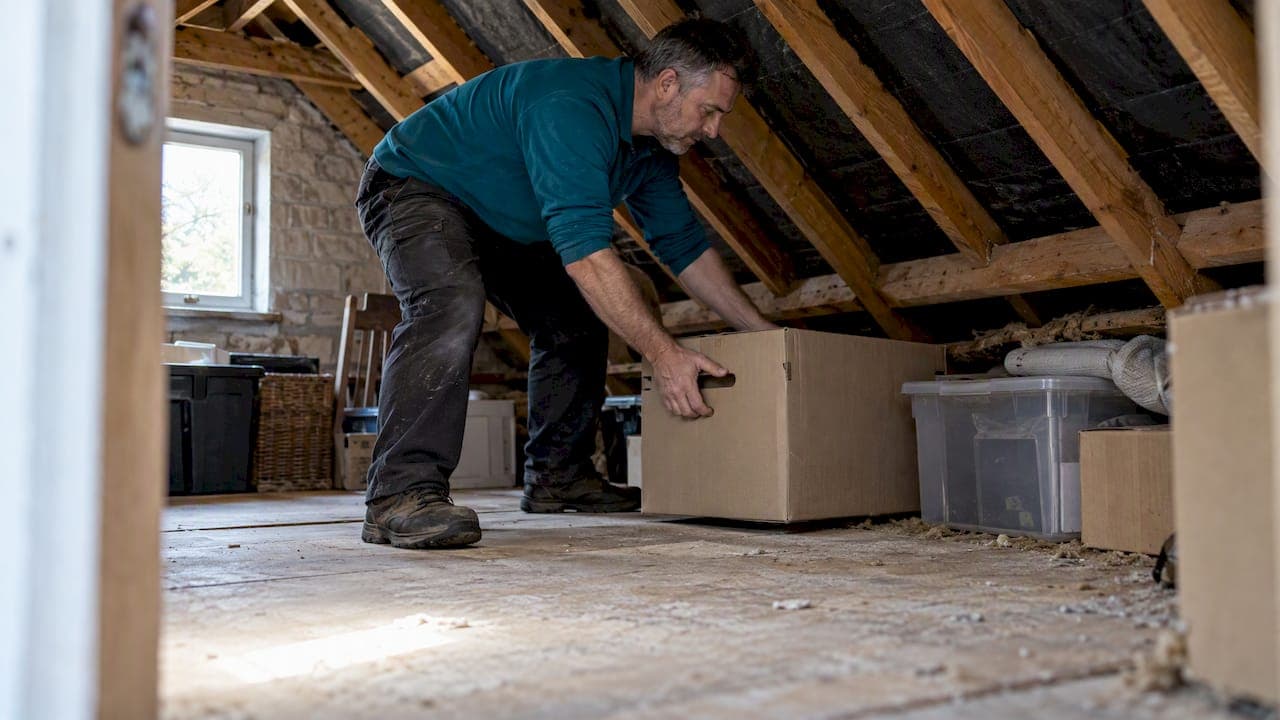
- Move stored boxes and valuables off the attic floor and away from hatch openings.
- Cover remaining boxes with waterproof tarps and label anything fragile.
- Photograph stored piles and vulnerable areas for your own records and for insurance if needed.
- Pull furniture away from exterior walls and spaces directly under eaves in upper rooms.
- Lay dust sheets over floors and upholstery, and tape down protective runners near doors crews will use for access.
- Unplug and shield large appliances or electronics near the work zone, and move small valuables to a sealed cupboard or off-site.
If your attic has loose-fill insulation or stored building materials, tell your contractor in advance. They may need to relocate or protect insulation to prevent it from shifting into living spaces or clogging gutters during tear-off. Our roof inspection checklist walks through photographing vulnerable areas safely if you want a head start before the crew arrives.
Pro Tip: Keep a small bag of essentials, chargers, and documents outside the attic and work zone for the duration of the job, so you're not digging through covered boxes mid-project.

Getting your garden, driveway, and vehicles ready
Outdoor spaces take as much preparation as the inside of your home, since scaffolding, material drops, and skip placement all need room to work safely.
- Clear garden furniture, planters, play equipment, and grills away from scaffolding footprints and material drop zones.
- Flag flush-mounted items such as sprinkler heads and low-voltage lighting with bright markers so they are not damaged when tarps or boards go down.
- Move vehicles off the driveway or agree a safe parking plan with your contractor, and keep access gates clear for deliveries.
- Lay boards or temporary coverings over lawns and planting beds that will see repeated foot traffic or material movement.
- Agree in advance where a waste skip will sit for the duration of the job.
A little flagging and clearing up front avoids most of the accidental damage that frustrates homeowners after a project wraps up.
Keeping children, pets, and vulnerable family members safe
A roof replacement turns your garden and driveway into an active work site, and that calls for clear boundaries at home.
- Set up a visible no-go zone around scaffolding and material storage, and walk the family through it before work starts.
- Agree safe indoor and outdoor routes that keep children and pets well clear of ladders, debris, and tool storage.
- Consider short-term boarding or a relocation plan for pets on days with heavy noise or dust, particularly for anxious animals.
- Secure windows and doors near the work area, and double-check that pet microchip details are current in case a gate is left open.
- Set up a quiet room with ear protection available for anyone sensitive to noise, and plan to be out of the house during the loudest phases if possible.
Pro Tip: Ask your contractor which day is likely to be the noisiest, usually tear-off, and schedule outings or pet boarding around that one day rather than the whole project.
What to confirm with your contractor and neighbors before day one
Clear agreements in writing head off most of the friction that comes up during a roof replacement. Before signing off, confirm:
- Start and end dates, along with daily working hours.
- Parking arrangements, delivery windows, and vehicle access routes.
- Who is responsible for skip placement and daily debris cleanup.
- A named on-site supervisor and an emergency contact number.
- Proof of insurance and references from recent, comparable jobs.
- A simple plan for weather delays and how issues get raised and resolved.
It also helps to give neighbors a heads-up about dates, parking changes, and a contact number for the day, since scaffolding and skips often spill into shared spaces. Our roof maintenance plan guide covers what records and contracts to keep on file once work begins, which makes the eventual handover far easier. For a second opinion on vetting a contractor's credentials before signing anything, this guide to contractor background checks covers what to ask for and why.
Your week-of and day-of roof replacement checklist
Roof replacement timelines vary with the size and complexity of the job, with most residential projects taking a few days on the roof itself, though the full process from quote to completion often runs several weeks once materials and scheduling are factored in. A simple, ordered checklist keeps the final stretch manageable.
- One week before: Confirm all documentation (insurance, risk assessment, method statement), photograph vulnerable areas inside and outside, move large items out of the attic, and firm up pet and vehicle arrangements.
- 48 hours before: Clear the driveway and immediate work area, protect plants and lawn sections, and reconfirm delivery times and parking with your contractor.
- Morning of: Walk the site with your contractor, check that access gates are unlocked and clear, move any remaining small valuables, and brief the household on the day's safety zones.
- End of day and post-job: Inspect finished work, take your own photographs, note anything for a punch-list, and confirm the cleanup plan and final sign-off date.
For a closer look at how these phases typically unfold on a real project, our roof replacement timeline for Kent homes breaks down what happens day by day. A seasonal home-prep workflow like this practical guide to seasonal updates can also help you fold roof work into a broader household schedule.
Why a competent roofer makes preparation easier
Working with an experienced, properly insured contractor removes much of the guesswork from preparation, since they will tell you exactly what to expect and when. We bring over 10 years of experience to roofing projects, with fully insured workmanship and a 24-hour emergency response service for issues that cannot wait.
- Family-owned and insured, with more than 10 years of roofing experience.
- 24-hour emergency response for urgent repair needs alongside planned replacement work.
- Free, no-obligation quotes with a clear written scope before any work begins.
A proper site survey should leave you with a written quote, a realistic timeline, and a plan for materials and access. If you are still weighing replacement against repair, our guide to deciding between the two walks through the cost and condition factors that usually settle the question.
Living through a roof replacement: what to expect
A roof replacement is noisy and disruptive for a few days, and that is normal rather than a sign something has gone wrong. Most of the disruption clears quickly once tear-off is done and new materials go on. Clear communication with your contractor and the small preparations above head off most problems before they start. If you do spot damage or a missed item, document it with a photo and raise it with your contractor right away rather than waiting until the job wraps up.
— Gabbi
How J.H. Roofing supports your roof replacement
We offer roof replacements across Kent backed by insured workmanship, free no-obligation quotes, and a 24-hour emergency response service for anything that cannot wait until your scheduled start date. If you spot a smaller issue while preparing, such as a loose tile, our repair services cover one-off fixes without waiting for a full replacement.

The next step is straightforward: request a site survey and ask us for a written risk assessment and method statement alongside your quote. You can also browse our full range of roofing services if your project includes guttering, flat roofing, or chimney work alongside the main replacement. Get in touch to book your survey and get a clear, written plan for your project.
FAQ
What materials do you need to install a new roof?
A new roof typically needs underlayment, roofing material such as tiles, slate, or felt depending on your chosen covering, flashing for joints and chimneys, ridge caps, and fixings. Your contractor's written quote should list the exact materials and specifications for your property, since choices vary by roof type and local building style.
Should you insulate between roof rafters?
Insulating between rafters is a common approach for converted or warm-roof lofts, though the right method depends on your roof type and ventilation needs. It's worth discussing insulation placement with your contractor during the planning stage, since it affects how materials are handled during replacement.
Is $30,000 too much for a roof?
Roof replacement costs vary widely by property size, roof type, and materials chosen, and we do not publish a fixed price list since every quote reflects the specific job. The clearest way to know if a quote is reasonable for your property is a free, no-obligation site survey and written estimate.
How much does it cost to reroof a 3 bedroom house?
Cost depends on roof size, pitch, material choice, and any additional work such as flashing or guttering, so there is no single figure that applies to every home. Requesting a free quote after a site survey is the most reliable way to get a cost specific to your property.