
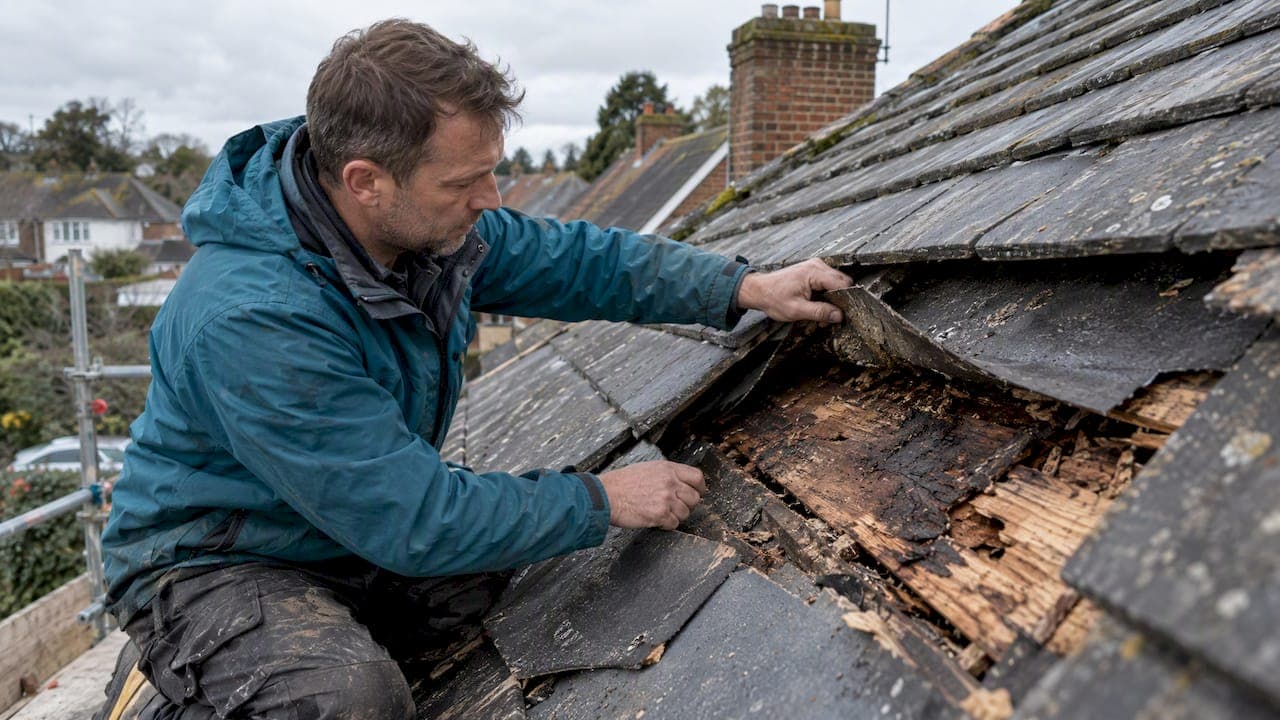
Rotten roof decking almost always needs replacing rather than a surface fix, because boards that have lost strength cannot hold fixings or carry the covering. Limit the leak with a temporary cover, then book a professional survey. Widespread damp, sagging or soft areas make replacement the safest route, and large jobs can trigger building regulations.
TL;DR:
- Patch a few damaged boards only when the joists are sound; widespread rot or damaged joists call for professional assessment and often full replacement.
- Use OSB/3 or OSB/4 to BS EN 300, at least 18mm thick, or plywood to BS EN 636 service class 2.
- Replacing at least 50% of the roof surface or altering its structure typically requires building regulations approval and may trigger insulation upgrades; contact building control early.
- If the roof feels soft, stop inspecting and stay off it; use a tarp secured from inside or by a professional, then arrange a survey.
- For damage linked to an insurance claim, notify the insurer before work starts; dated photographs can document the damage and support the claim.
Table of Contents
- How do you spot rotten decking from outside and from the loft?
- What causes roof decking to rot?
- Which decking materials are used, and how do they fail?
- Can you patch rotten decking, or do you need a full re-deck?
- What does a contractor do when replacing rotten decking?
- When do building regulations and insurance come into play?
- How can you stop decking rot from coming back?
- Why does a qualified roofer protect you from repeat failures?
- How can we help with rotten decking?
- FAQ
- Sources
How do you spot rotten decking from outside and from the loft?
Start outside, from the ground or a window. Look for slipped tiles or slates, a visible dip in the roofline, and moss or algae sitting in patches, which often means moisture is being trapped. Then check the loft with a torch. Wet or dark boards, a musty smell and daylight where there should be none all point to trouble.
- Soft spots or sagging that you can see or feel from a ladder or loft hatch
- Ceiling stains, bubbling paint or sagging plasterboard below the affected slope
- Black mould or a musty smell in the loft space
- Hollow or dull sounds when you tap boards from inside with a screwdriver handle
- Delaminating or swollen board edges, especially on oriented strand board (OSB)
A leak and condensation can look alike on a ceiling, so it helps to know which one you have. This guide to telling condensation from a leak is a useful starting point.
Keep your feet off any roof area that looks or feels soft. Structural sag, large wet patches or boards peeling apart in layers are red flags. If you see any of them, stop inspecting and call a professional roofer.
What causes roof decking to rot?
Decking rots when it stays wet for long periods. Timber and board materials can handle the odd soaking, but they need to dry out afterward. The usual culprits are these:
- Chronic leaks from failed flashing, a leaking dormer, worn leadwork or tired coverings, where the same patch gets wet again before it dries
- Condensation from poor loft ventilation or insulation that blocks airflow, which is why flat roof design guidance stresses ventilation and correct vapor control layer placement
- Standing water on flat roofs, blocked gutters, or pockets that collect at valleys and parapets, a risk that moisture management guidance for timber structures recommends designing out with proper drainage
- Ice damming at the eaves, where trapped meltwater keeps the lowest boards saturated through winter
Once boards have been wet long enough, the damage compounds. Fixings lose their grip, which raises the risk of the covering lifting in high winds. If you suspect poor airflow is part of the story, our blog explains the roof ventilation gaps UK homes need.
Which decking materials are used, and how do they fail?
Most UK roofs are decked with OSB, plywood or, on older properties, timber boarding. Technical guidance says roofing OSB should be OSB/3 or OSB/4 made to BS EN 300 with UKCA marking, that decking boards should be at least 18mm thick, and that plywood should meet BS EN 636 service class 2 as a minimum.
- OSB swells at the edges and delaminates once it has been repeatedly wet
- Plywood tends to break down along its edges and between layers
- Timber boarding rots locally, often around a leak, while nearby boards stay sound
Installation matters as much as the material. Site-applied roof system guidance calls for staggered joints, expansion gaps of 3–5mm between boards, a perimeter gap of at least 10mm, and correct fixing types and spacing. Skip any of these and boards can buckle or fail early.
Using the right grade also protects any manufacturer warranty on the covering. Our comparison of OSB3 and plywood for roof decking helps you see which suits your roof.

Can you patch rotten decking, or do you need a full re-deck?
A patch works only when a few boards are damaged and the joists beneath are sound. Widespread rot calls for a full re-deck. Here is how we think it through:
- Limit the damage first. A tarpaulin secured from inside the loft or by a professional, plus buckets under drips, buys time. Avoid climbing onto a wet or soft roof yourself.
- Count the damage. A handful of isolated boards can be cut out and replaced, with new boards fixed to sound joists.
- Check the joists. If rafters or joists are soft, cracked or stained through, the repair becomes structural and needs a qualified roofer, and sometimes a structural engineer.
- Look at the leak history. Repeat leaks in the same area usually mean the first repair treated a symptom.
- Weigh the regulations. Large re-decking can bring insulation upgrades and building control involvement, covered below.
Pro Tip: Photograph the damage from the loft before any work starts. Dated photos help your roofer scope the job accurately and support any insurance claim.
Practitioners warn that ignoring decking rot is a false economy, since a deck that cannot hold fixings securely puts the whole covering at risk in high winds. For help weighing a patch against replacement, see why overlays often cost more over time.
What does a contractor do when replacing rotten decking?
Knowing the sequence helps you judge a quote and ask sensible questions. A professional job usually follows this order:
- Survey and scope. The covering is stripped back so the deck and joists can be properly assessed, not just the visible damage.
- Removal. Rotten boards come off, and any damaged joists are repaired or sistered before new decking goes on.
- New decking. Boards of the correct grade and thickness are laid with staggered joints, expansion gaps and the right fixings.
- Insulation and underlay. Whether the roof is a warm or cold deck affects the membrane and the insulation details, particularly on flat roofs finished in GRP.
- Re-covering and finishing. Flashings, leadwork and the covering go back, and the roof is checked for watertightness.
Timelines depend on roof size and weather, so ask for a written estimate. Insulation upgrades required by building regulations can add time and cost, so raise that early. Our attic and safety checklist for roof replacement shows how to prepare your home before the crew arrives.
Questions worth asking any contractor:
- Are you insured, and can I see the certificate?
- Which accreditations do you hold?
- Who handles building regulations, and do you self-certify?
- What is the project timeline and warranty?
When do building regulations and insurance come into play?
Regulatory triggers often change scope and price, so check them before work begins.
- Replacing 50% or more of a roof's surface area, or altering the structure, typically needs building regulations approval and can force an insulation upgrade to current energy standards.
- A new covering weighing more than 15% above the original, or with weaker fire performance, needs checking against local authority guidance.
- Gov for roof covering replacement, and it points you to your local rules.
- Contact local authority building control early, and ask your installer whether they self-certify.
- If the work follows a claim, tell your insurer before starting.
Getting this right protects warranties and resale. Related pitfalls are covered in our post on planning and building regs mistakes.
How can you stop decking rot from coming back?
Prevention is mostly routine, and it costs far less than re-decking.
- Clear gutters and valleys and remove moss so water cannot pool on the roof or against walls
- Keep loft vents open and make sure insulation does not block airflow at the eaves
- Fix flashing and leadwork quickly, and check them after storms
- Inspect after heavy rain and freeze-thaw spells, from the ground and from the loft
Pro Tip: Check your loft after the first heavy rain of each season. Catching a damp patch early can mean replacing one board instead of twenty.
Why does a qualified roofer protect you from repeat failures?
Temporary measures are fine for a homeowner: a tarp, a bucket, a call to a professional. Long-term repairs are different. Getting the decking grade, fixings and expansion gaps right takes experience, and so does handling building control. Cheap shortcuts can lead to repeat leaks. Hands-on trades see this pattern constantly: the board that failed was often the one laid without appropriate gaps or with the wrong fixings. The roof is your home's first defense, and it deserves a compliant, properly documented fix.
— Gabbi
How can we help with rotten decking?

Whether you have a damp patch or an active leak, we can diagnose the cause and fix it properly. Our family-owned team has extensive experience across Kent, and we are rated 4.7 stars on Google.
- Roof repairs and maintenance, including leadwork and chimney repairs
- Roof replacements and re-decking
- Flat roofing and new roof installations
- emergency repairs for urgent leaks
We offer free, no-obligation quotes. Ask us how we handle building regulations and insulation upgrades, and we will explain it plainly. Request your survey today.
FAQ
How do you fix a deck that is rotting?
Cut out the rotten boards, check the joists beneath, and fix new boards of the correct grade to sound timber. If rot is widespread or the joists are affected, a full re-deck is the safer route. A professional survey will confirm which applies.
Can you replace rafters without removing the roof?
Sometimes. Damaged rafters can often be repaired by fixing a new timber alongside the old one (sistering), but that usually means stripping the covering from the affected area. Structural work should be assessed by a qualified roofer or engineer.
How long should roof decking last?
Properly installed decking that stays dry can last as long as the roof itself, often decades. Lifespan depends on material, ventilation and how quickly leaks are fixed. Practitioner guidance warns that ignored rot shortens it considerably.
What minimum thickness and grade should replacement decking be?
Technical guidance specifies boards that meet the appropriate thickness specification, with OSB/3 or OSB/4 to BS EN 300 or plywood to BS EN 636 service class 2. Your roofer should confirm the exact specification for your roof.
Sources
- Guidance for re-roofing projects
- 2.5 Application of panels in flat roof decking
- Structural Roof Decks | Radmat