
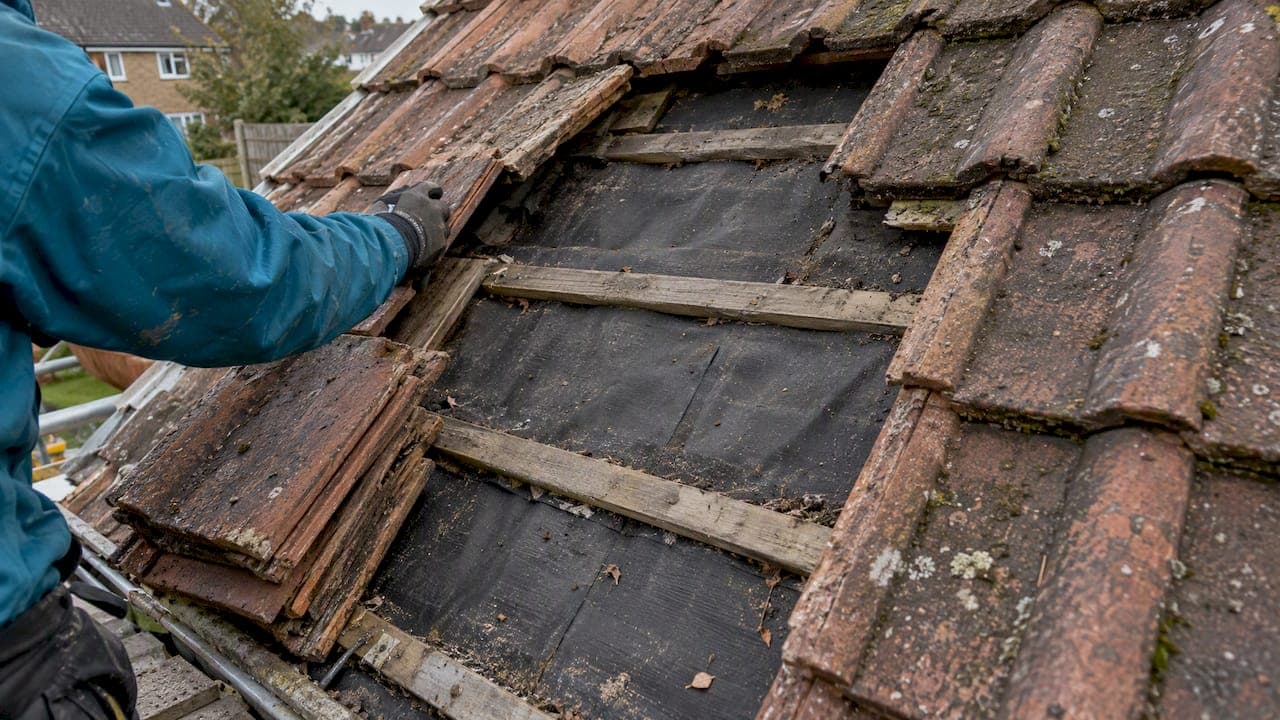
You cannot properly replace the underlay (the old "roof felt") under your tiles without lifting the tiles. The tiles are fixed to battens, the battens sit over the underlay, and the underlay lies over the rafters. To renew it, a roofer strips the affected area, lays new membrane, re-battens and puts the tiles back or replaces them. This guide explains when that is worth doing, what it typically costs in the UK, what to ask your roofer, and where a smaller repair is enough.
TL;DR
- Underlay sits beneath the battens and tiles, so replacing it means taking the tiles off. Anyone offering to do it from the loft is offering a short-term patch.
- Industry estimates for 2026 put a full re-felt of an average three-bedroom semi at £2,000 to £7,300, and a small patch from around £200.
- Ask which membrane is going on, whether it meets current wind-uplift requirements, and how the roof will be ventilated afterwards.
- Listed buildings and conservation areas may need consent before you strip a slope. Check with your local council first.
- If the tiles are in good condition and only one area is damaged, a targeted repair can be far cheaper than a full re-felt.
Table of Contents
- What the underlay does and why it fails
- Signs your underlay needs attention
- Why you cannot do it from the loft
- What the job involves, step by step
- Choosing the membrane
- What does it cost?
- Patch repair or full replacement?
- Rules, consents and building regulations
- Our view on underlay replacement
- Getting a quote from J.H. Roofing
- Questions to ask before you sign
- FAQ
- Sources
What the underlay does and why it fails
Underlay is the second line of defence under your tiles. Tiles shed most of the rain, but wind-driven rain, snow and dust still get past them. The underlay catches that moisture and lets it run down into the gutter. In a modern roof, a breathable membrane also lets water vapour from the house escape, which protects the timbers from condensation.
Traditional bitumen felt does not last for ever. Checkatrade's cost guide puts the life of traditional felt under tiles at around 20 to 30 years, with modern breathable membranes lasting longer. In practice, how fast it ages depends on:
- How well the roof is ventilated and how hot the loft gets.
- Whether slipped or broken tiles have let water and sunlight reach it.
- How it was fitted: tight, sagging, or torn at laps and around chimneys.
- The quality of the original material. Very old felt can turn brittle and dusty.
On Kent homes built in the mid-20th century, original felt is often past its working life by now. That does not mean every roof needs stripping. It means the underlay is worth checking whenever the tiles are being worked on.
Signs your underlay needs attention
You rarely see underlay failing directly. You see what it lets through. Look for these from inside the loft, with a torch and without leaning on the ceiling joists:
- Daylight or sagging felt between the rafters. Torn, drooping or split felt is the clearest sign.
- Damp patches or dark staining on rafters, battens or the felt itself, especially below the ridge or around the chimney.
- Brittle, crumbling felt that flakes when disturbed, or bits of felt lying on the insulation.
- Persistent condensation on the underside of the roof covering, or mould on timber.
- Leaks that tile repairs have not cured. If a roofer has replaced slipped tiles and the stain keeps returning, the membrane beneath may be the problem.
If you see missing or slipped tiles from the ground as well, read our guide on when missing roof tiles are an emergency. Water getting in around a gap can damage the felt long before you notice a drip.
Do not climb onto the roof to investigate. A drone roof survey, which we offer, lets us look at the whole covering without ladders on your tiles and gives you photos of what we find.

Why you cannot do it from the loft
It is tempting to fix the underlay from the inside. It rarely works, and some of the common ideas cause harm.
- Taping tears. You might be able to tape a small, isolated tear in a modern breathable membrane. Old bitumen felt is usually too brittle and dusty for tape or sealant to bond, as one roofing firm explains.
- Stapling new membrane between the rafters. This can trap moisture against the timbers and set up rot.
- Spraying foam on the underside. Same risk, and it can also cause trouble when you come to sell or remortgage, because surveyors flag it.
The mechanics are simple. The membrane has to run continuously over the rafters, with laps overlapping downhill, and be held by the battens. You can only get at it by removing the tiles and battens above it. A quote that skips this step is a patch, and you should be told so.
What the job involves, step by step
A full underlay replacement on a pitched tile roof usually follows this order:
- Survey and scaffold. We inspect the roof, the loft and the existing tiles, and agree the scope. Scaffolding is normally needed for safe access.
- Strip the tiles and battens. Tiles are stacked and sorted. Sound tiles can be reused. Cracked or perished ones are set aside for replacement.
- Remove the old underlay and check rafters, wall plates and any felt-covered timbers for rot or damage.
- Repair the structure where necessary: replacing damaged rafters, treating timber or fixing gaps.
- Lay the new membrane from the eaves upward, with correct overlaps, and detail it at valleys, hips, abutments and the chimney.
- Fit new treated battens at the right gauge for your tiles.
- Re-tile. Tiles are fixed to current guidance, with ridge, hips and verges bedded or fixed as appropriate.
- Check ventilation at the eaves and ridge, and leave the roof watertight at the end of each day.
Because the roof is open, this is the best moment to fix flashings, lead work, fascia and soffit problems and ventilation. It also helps to prepare the loft beforehand. Our checklist on preparing for roof replacement covers the attic steps and safety checks.
Choosing the membrane
There are two broad families of underlay:
| Type | What it is | Where it fits |
|---|---|---|
| Traditional bitumen felt | Non-breathable sheet. Relies on a ventilated roof space to clear moisture. | Older roofs with generous airflow. Less common on new work. |
| Breathable (vapour-permeable) membrane | Synthetic sheet that lets water vapour pass through while stopping liquid water. | Most modern re-roofs, and the usual choice where the loft is insulated or converted. |
Within breathable membranes, you will hear about Type LR (low resistance) and HR (high resistance) types. A specification document from a UK housing scheme shows how a Type LR underlay as defined by the British Standard is specified for a room-in-the-roof construction. Which one suits your house depends on the roof build-up, the insulation and the tiles. Do not choose on price alone.
The British Standard behind all this is BS 5534, the code of practice for slating and tiling of pitched roofs. Underlays should be tested for wind-uplift resistance, and cheaper membranes may not meet current requirements. Ask your roofer to name the product and give you the data sheet.
The ventilation trap
There is one risk many homeowners are never told about. An older roof is often "airy": the old felt is draughty, and that airflow keeps the timbers dry. Swapping it for a modern, airtight, high-performance membrane without adjusting the ventilation can create a condensation problem that did not exist before. The fix is in the detailing, at the eaves and ridge, and it has to be planned, not added afterwards.

Our article on roof ventilation rules in the UK explains the 10mm and 25mm figures you may have heard about and how to check them.
What does it cost?
Costs depend on roof size, access, tile type, scaffolding, the membrane and whether the tiles can be reused. These are the 2026 industry figures for the UK from Checkatrade:
| Job | Typical cost |
|---|---|
| Full underlay replacement, average three-bedroom semi | £2,000 to £7,300 |
| Small patch (around 4m²) | From £200 |
| Average per square metre | £50 |
These are national averages, not our prices. We do not publish a price for underlay replacement because it depends on your roof, and we quote after seeing it. What we can say is that a single tile repair with us starts from £150.
The wide range comes down to a few things:
- Whether tiles are reused. Sound tiles can go back on. Brittle or crumbling ones cannot, and replacing them adds to the bill.
- Roof complexity. Hips, valleys, dormers and chimneys all add labour.
- Timber repairs. Rot found once the felt is off is the usual source of extra cost, which is why a clear quote should say how it will be handled.
- Scaffolding and access. Terraced and tall properties cost more to scaffold.
If you are weighing a full re-roof against less invasive options, our piece on overlays versus replacement compares the cost per year, not just the upfront figure.
Patch repair or full replacement?
Not every roof needs a complete re-felt. A fair decision looks like this:
A patch is reasonable when:
- Damage is confined to a small area, for example under a few slipped tiles or around a flashing.
- The surrounding felt is still flexible and sound.
- The tiles are in good condition and can be lifted and relaid locally.
Full replacement is the better choice when:
- The felt is brittle or crumbling across the slope.
- You have leaks in several places.
- The tiles are due for replacement anyway. Re-felting at the same time avoids paying for scaffolding twice.
- You are converting the loft or adding insulation, which changes how the roof has to breathe.
If your roof is leaking now, do not wait for a perfect plan. Fast repairs for a leaking or damaged roof can make it watertight first, and the longer-term underlay decision can follow.
Rules, consents and building regulations
Two things can affect the work.
Building regulations. New roofs and major refurbishments are expected to meet current standards, including BS 5534 for slating and tiling. The common working rule is that replacing around a quarter or more of the roof area brings this into play, but check with your local building control or ask your roofer to confirm how the rule applies to your job.
Listed buildings and conservation areas. If your home is listed or in a conservation area, you cannot assume you can strip and relay a slope. Guidance from Babergh and Mid Suffolk councils says patch repairs of no more than 50% of one roof slope in matching materials would not need consent, while larger work or stripping a slope and re-laying it generally would. That is one council's guidance, not a national rule. Kent has many conservation areas, including parts of Canterbury, so contact your district council before work starts.
Our view on underlay replacement
We are a family-owned roofing firm working across Kent, and underlay is the part of the roof homeowners think about least until it fails. Here is how we approach it.
We will tell you plainly when a repair is enough. If the felt is sound and the problem is a few tiles or a flashing, a repair is cheaper and honest. If the felt is perished across a slope, we will say so, show you the evidence, and explain why lifting the tiles is the only proper fix.
We would rather quote for the right job than a cheaper job that fails. That means naming the membrane, stating how the roof will be ventilated and listing what happens if we find rotten timber. You get a free, no-obligation quote, and it should read clearly enough to compare line by line with anyone else's.
We also fit traditional Kent peg tiles, so where your roof has them, we can strip, sort and reuse the sound ones rather than replacing everything. And since we are insured, you can ask for proof before work starts.
If the worst happens, such as a storm taking tiles off and exposing the felt, we offer a 24-hour emergency response to make the roof safe first.
— Gabbi
Getting a quote from J.H. Roofing
If you think your underlay is failing, we can survey the roof, including by drone, tell you what condition it is in and quote for the right level of work. Start with our roof replacement service in Kent, or if the issue is smaller, our roof repairs team. The full list is on our services page. We work across Ashford, Canterbury, Maidstone, Folkestone, Hythe and the surrounding area, and our Google rating is 4.7 stars.
Questions to ask before you sign
Whoever you hire, put these to them in writing:
- Which membrane will you use, and can I see the data sheet?
- Does it meet the wind-uplift requirements in BS 5534 for my area and roof?
- How will the roof be ventilated afterwards, at the eaves and ridge?
- Will you reuse my tiles, and what will you replace if they are not fit?
- What happens if you find rotten timber, and how will it be priced?
- Are you insured, and can I see the certificate?
- Does my property need consent, and who applies for it?
A roofer who answers these clearly is usually a roofer who does the job properly.
FAQ
Can you replace roof felt without removing the tiles?
Not properly. The underlay lies under the battens and tiles, so the tiles have to come off to reach it. Anything done from the loft, such as taping or stapling, is a temporary patch and can trap moisture if done badly.
How often should roof underlay be replaced?
Traditional felt under tiles typically lasts around 20 to 30 years, and modern breathable membranes can last longer. Condition matters more than age, so have it checked if you see leaks, sagging or brittle felt.
What is the lining under roof tiles called?
It is called underlay, and some people still call it roofing felt. Modern versions are breathable membranes. It is laid over the rafters and under the tile battens.
How much does it cost to re-felt a roof?
The 2026 Checkatrade figures put a small patch from around £200 and a full re-felt on an average semi at £2,000 to £7,300. Your price depends on roof size, access and any timber repairs, so a survey is the only way to get an accurate number.
Sources
- Replacing roof felt under tiles: Cost breakdown 2026, Checkatrade
- Re-felting a roof costs: 2026 UK price guide, Checkatrade
- BS 5534:2014+A2:2018, BSI Knowledge
- Roof coverings: traditional materials, repairs and detailing guidance, Babergh and Mid Suffolk
- Construction Specification 2016, Cherwell planning register
- Replace roof felt without removing tiles, Professional Roofers