
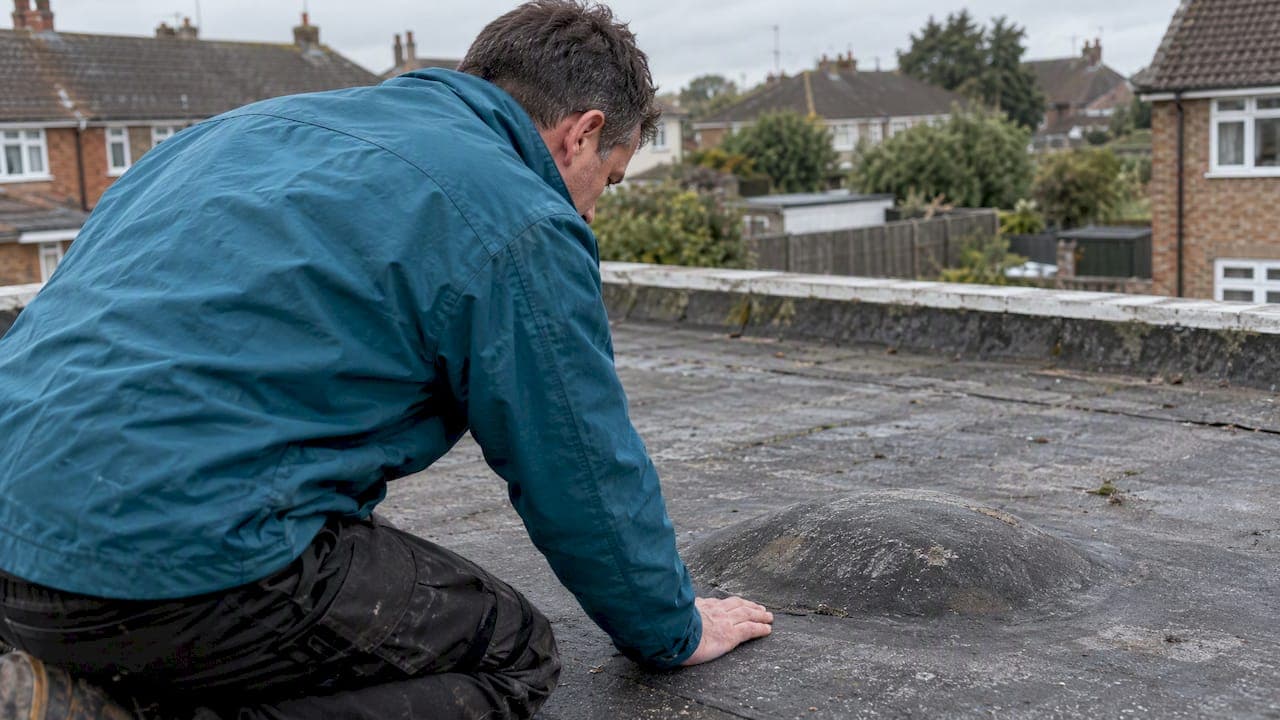
A blister on a flat roof is a raised pocket where air, moisture or vapor has become trapped under the surface and expanded in the heat. Many are harmless for a while. Others are the first sign that the waterproof layer has lost its grip on the roof below. The difference comes down to size, position and whether the surface has split. This guide shows you how to tell which you have, what a sensible repair looks like, and when it is cheaper to stop patching.
TL;DR
- A small, intact blister away from edges, seams and pipes can often be monitored. A blister that has split, cracked or grown large needs a roofer.
- The usual cause is moisture or air trapped during installation, then pushed outward by sun. Fixing only the bubble without finding the source means it tends to return.
- Felt, GRP and rubber roofs all blister, for different reasons. The repair method depends on the material.
- Do not cut a blister open and leave it. Cutting without drying and sealing the layers below lets water in.
- If repairs keep recurring or the deck is soft, replacement usually makes more sense than another patch.
Table of Contents
- What a flat roof blister actually is
- What causes blisters on flat roofs
- Felt, GRP and rubber: how blisters differ
- Is it safe to leave a blister alone?
- What not to do
- How blisters are properly repaired
- What blister repairs cost
- Repair or replace?
- Preventing blisters and maintaining a flat roof
- Our view on flat roof blisters
- Need a flat roof checked in Kent?
- FAQ
- Sources
What a flat roof blister actually is
A blister is a raised area caused by internal pressure from trapped air, moisture or vapor, either between layers of roofing material or between the membrane and the surface beneath it. Scotland's Building Conservation Centre describes how rising surface temperature in sunny weather makes that trapped material expand and lift the membrane. That is why you often notice blisters after a hot spell, and why some seem to shrink again in cooler weather.
The important point is what the blister tells you. It means the layers are no longer fully bonded at that spot. While the surface is intact, the roof is still waterproof. Once it splits, you have a direct route for water into the roof build-up.
You may hear the same problem called bubbling, pillowing or ballooning. On a felt roof it feels like a firm or slightly spongy dome. On a GRP roof it can look like a raised, sometimes cloudy patch in the resin or topcoat. On a rubber (EPDM) roof it appears as a bubble under the sheet, often where the adhesive has not bonded.

What causes blisters on flat roofs
There is rarely one cause. Most blisters come from a combination of the build-up and the weather.
Moisture trapped at installation
Professional roofers consistently point to trapped moisture as the most frequent cause. Alliance Roofing explains that this comes from poor bonding, dusty or dirty surfaces, or damp already present in the roof structure when the new layer went on. Sun then heats that moisture, it expands, and the membrane is pushed upward.
In practice this happens when a roof is laid over a damp deck after rain, when old insulation is left wet, or when the work is rushed at the end of the day as weather turns.
Poor adhesion and workmanship
On felt roofs, weak bonding between layers lets pockets form, particularly if the surface was not cleaned or primed. On rubber roofs, Plytech lists moisture evaporating from water-based adhesive and trapped solvent vapors from contact adhesive among the common reasons for bubbles under the sheet.
Heat, age and ponding water
Sun alone does not create a blister, but it drives one. Older felt becomes brittle and loses flexibility, so it tears or lifts more readily. Standing water makes things worse: it speeds up ageing of the surface and finds any weak point. Design matters here too. The roofing guidance summarized by Squote highlights correct falls, which prevent ponding, as the main defense against the long-term deterioration that leads to blistering. If you have puddles that stay for days, read our 48-hour test for flat roof ponding.

Warm, moist air from inside
In a poorly ventilated build-up, warm moist air from the building can find its way into the roof layers and condense. This is more likely on older extensions and garage conversions where insulation has been added without considering airflow.
Felt, GRP and rubber: how blisters differ
| Material | What a blister looks like | Usual cause | Typical approach |
|---|---|---|---|
| Bitumen felt (torch-on or built-up) | Domed lump, may feel hollow or spongy, often along laps | Trapped moisture or air between layers, aged felt | Cut out, dry, patch with new layers, or overlay if the roof is sound |
| GRP (fiberglass) | Raised patch, cloudy resin, sometimes hairline cracks | Moisture in the deck at lay-up, poor resin cure, movement | Grind out, dry, re-laminate and topcoat |
| EPDM rubber | Bubble under the sheet, often in hot weather | Adhesive not fully bonded, trapped vapor | Often monitored if small; lifted and re-bonded if it grows |
The Plytech guidance on rubber roofs is a useful reminder that not every bubble on a rubber roof is a defect in the sheet itself. Because a single piece of EPDM has few seams, it is generally a lower-risk choice than aged felt, according to the materials overview from Squote. If you are weighing up materials for a new roof, our guide to flat roofing options for Kent homes compares them, and our piece on single ply versus built-up helps property managers decide.
Is it safe to leave a blister alone?
Sometimes. The Canadian Roofing Contractors Association notes that intact blisters are a common feature of built-up roofs, and that a small, stable one away from seams, edges or penetrations may not compromise the roof. The same guidance makes clear they should be watched, and repaired when they sit in areas that get foot traffic or have grown noticeably.
Use this quick check from the ground or a window. Never walk on a roof you cannot reach safely, and do not use a ladder alone on a wet or windy day.
- Size. Photograph it with a tape measure or coin beside it. Blisters around 600mm (about 2ft) or larger usually need professional attention, according to Up Top Roofing.
- Position. A blister on a lap, at an upstand, around a rooflight or near an outlet is more serious than one in the middle of a sheet.
- Surface. Look for cracks, splits, exposed fibers or missing granules. A split blister is an immediate breach in the waterproofing.
- Change. Re-photograph weekly for a month, and after hot days. A growing blister is a warning.
- Inside. Check the ceiling below for stains, a musty smell or a patch that feels damp.
If the roof is leaking or the blister has split, treat it as urgent. Our guide to emergency roof repair costs and safety in Kent explains what to expect and what to do while you wait.
What not to do
- Do not pop or slice it and leave it. You will let water into a build-up that was only trapped, not open.
- Do not paint over it. Coatings applied over a live blister will blister too, because the moisture is still beneath.
- Do not use roofing sealant as a permanent fix. It may hold for a few weeks and then peel as the roof moves.
- Do not stand on it. A blister can be hollow and the layers beneath can tear.
- Do not ignore ponding. If water sits near the blister, the cause may be a deck that has sagged.
How blisters are properly repaired
A repair that lasts follows the same order whatever the material.
- Find the extent. A good roofer checks around the visible bubble, because the bonded area next to it is often already weak. A drone roof survey helps on larger or higher roofs without anyone stepping on a fragile surface.
- Open and dry. The blister is cut out neatly. Wet insulation or deck is removed or dried, not covered over.
- Check the deck. If the board beneath is soft or rotted, a patch will fail. The Up Top Roofing guidance on repair versus replacement is clear that a damaged substrate usually points to replacement.
- Rebuild the layers. On felt this means new layers lapped over the old, bonded properly, with edges sealed. On GRP it means grinding back, re-laminating and applying a fresh topcoat.
- Deal with the source. If damp insulation, poor ventilation or ponding caused the blister, that must be corrected, or the patch just moves the problem.
Liquid coatings for tired roofs
For an ageing bitumen or felt roof that is not ready to be stripped, liquid-applied systems are an option. The manufacturer's information on GacoFlex silicone describes repairing major blisters locally and then overcoating the whole surface, with a claimed extension of 20 years or more. That is a manufacturer claim, so ask any installer for the guarantee terms and what the existing roof must look like to qualify. It is not suitable over a wet or rotten roof.
What blister repairs cost
Prices vary with access, size and material, and no honest roofer can quote a blister without seeing it. For context, Up Top Roofing's 2026 guide puts simple defect repairs between £60 and £1,000, with a typical leaking roof repair call averaging around £375. The same source gives approximately £100 to £140 per m² for bitumen flat roof repair work.
It reports £1,875 to £3,000 for a standard replacement of a medium 25m² flat roof, and £4,250 to £7,500 for a full strip and rebuild with new deck and insulation. Those are national figures, not our prices. We give free, no-obligation quotes for Kent properties, so you see a figure based on your own roof.
Repair or replace?
Patching is sensible when the damage is local, the deck is dry and firm, and the rest of the roof is in reasonable condition. Replacement starts to win when:
- blisters are spread across the surface rather than in one spot;
- you have had several repairs in a few years;
- the deck is soft, or insulation is wet;
- the roof is at the end of its expected life;
- water is ponding because the falls are wrong.
A useful rule of thumb is on our page about when Kent homeowners should replace a roof, which looks at the point when repair spend approaches the cost of a new roof. If you are also thinking about the property's value or a sale, this article on roof replacement versus selling looks at how a roof decision weighs against the home's sale, though its figures are in US dollars and its context is American.
Building Regulations when you replace
Replacing the waterproof layer can trigger insulation requirements. Guidance from the Church Growth Trust on recovering felt roofs explains that under Part L of the Building Regulations a flat roof is a thermal element, and renovating or replacing it can require the insulation to be upgraded. The research we reviewed cites a U-value target of 0.18 W/m²K when more than 50% of the roof is refurbished. Building Regulations can change, so confirm the current requirement with your roofer or local building control before work starts. Added insulation also needs proper ventilation to manage moisture, which is one way to avoid new blisters. Our guide to roof materials and 270mm insulation covers the related checks.
Preventing blisters and maintaining a flat roof
Most prevention happens at installation. After that, it is mostly regular looking.
- Insist on a dry deck. Roofing should not be laid over damp boards or wet insulation. Ask what moisture checks are done.
- Choose the build-up for the building. Ventilation and a vapor control layer matter as much as the top membrane.
- Keep outlets and gutters clear. Standing water ages the surface.
- Inspect twice a year. Spring and autumn are sensible. Our end-of-summer roof maintenance tips list what to look for after hot weather.
- Limit foot traffic. Use walkway tiles if you need regular access for aerials, solar fittings or plant.
- Photograph and date anything unusual. A record makes it easy to see if a blister is growing.
- Remove moss and debris gently. Scraping can damage the surface.
The Historic Environment Scotland guide on maintaining bituminous felt roofs stresses regular inspection so that problems are spotted and rectified as early as possible. That advice is as true in Kent as anywhere.
Our view on flat roof blisters
We are a family-owned roofing business working across Kent, and flat roof blisters are a problem we see regularly in places like Ashford, Folkestone, Canterbury and Maidstone. Our view is simple: the blister is rarely the real problem.
When a homeowner calls, the first thing we want to understand is why the layers lifted. If we only patch the bump and leave damp insulation or poor ventilation, we have sold a short-term fix. A good repair costs a little more in time, because it involves opening up the area, checking it is dry, and telling you honestly if the roof beneath is worth saving.
We would rather tell you that a small intact blister can be watched than book a job you do not need. We would also rather say plainly when a roof is beyond economical repair. That is what our free, no-obligation quotes are for: you get a clear scope, then you decide.
If water is coming in, do not wait for the weather. Our 24-hour emergency response exists for exactly that situation.
— Gabbi
Need a flat roof checked in Kent?
We repair and replace flat roofs on homes, extensions and commercial buildings across Kent, including felt and GRP, and we can arrange a drone survey where access is awkward. See our flat roofing and repair services, look at our flat roof replacement case study, or go to our page for leaking or damaged roofs if water is already getting in. Quotes are free and carry no obligation.
FAQ
Will flat roof blisters go away on their own?
Some shrink in cool weather as the trapped air contracts, but the underlying loss of adhesion remains, so they usually return in the next hot spell. Do not treat a blister that has gone down as fixed. Keep checking it, and have it looked at if it comes back larger.
Can I fix a blister on my own roof?
A small touch-up on a tiny, intact blister is sometimes described as low-risk where the roof can be reached safely, but cutting and patching felt or GRP properly means drying and rebuilding layers. Working at height is a real danger. For anything beyond a minor cosmetic spot, use an insured roofer.
Are blisters a sign I need a new roof?
Not necessarily. One or two isolated blisters on an otherwise sound roof can often be repaired. Widespread blistering, a soft deck or repeated repairs are stronger signs that replacement is the better value.
Do EPDM bubbles go away?
Small bubbles under a rubber sheet can be harmless, particularly in hot weather, and may settle. If a bubble grows, sits on a seam or the sheet looks stretched, have a roofer check the bond.
How quickly should I act on a split blister?
Treat it as urgent. A split or cracked blister is an immediate breach in the waterproof layer, so water can reach the deck and insulation. Cover it temporarily only if you can do so safely from inside or ground level, and call a roofer the same day.
Sources
- Bituminous Sheet Flat Roofs, Scotland's Building Conservation Centre
- Flat roof bubbling or blistering: causes and fixes, Alliance Roofing
- How to fix roof rubber bubbles in hot weather, Plytech
- Flat roof materials, Squote
- Blistering in Built-Up Roofs, Canadian Roofing Contractors Association
- Flat Roof Repair vs Replacement UK: Costs, Lifespan & Best Option in 2026, Up Top Roofing
- GacoFlex Roof Coating UK, Duratite
- Bituminous Sheet Flat Roofs: Their repair and maintenance, Historic Environment Scotland